


Wales's Ancient Druid Ceremony Was Invented 250 Years Ago by a Criminal
On 21 June 1792, a stonemason from Glamorgan stood on a hill in north-west London, scattered a handful of pebbles on the grass, and invented Welsh druidic tradition. Today, those pebbles have become elaborate stone circles. The ceremonies he wrote from scratch are performed before crowds of tens of thousands. And almost nobody knows he made the whole thing up.
How Do You Build an Ancient Tradition From Nothing?
The Gorsedd y Beirdd — the Gorsedd of the Bards — is the ceremonial heart of the National Eisteddfod, Wales's largest cultural festival. Every year, the Archdderwydd, or Archdruid, stands on the Maen Llog — the flat central stone of a circle of standing megaliths — raises a sword toward the sky, and intones the Gorsedd motto: Y gwir yn erbyn y byd. "The truth against the world."
Then he asks: A oes heddwch? "Is there peace?"
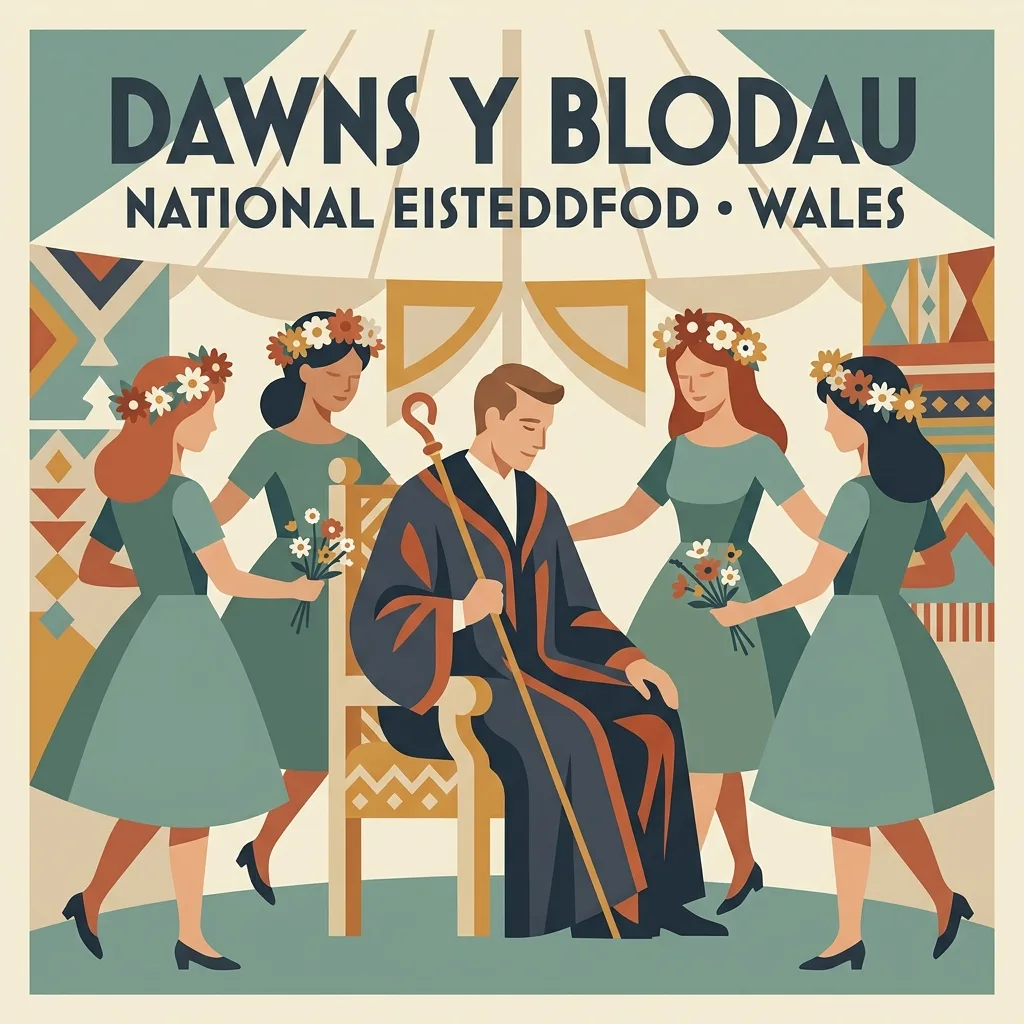
The crowd answers yes. The sword is sheathed. Poets in white robes receive their laurels. Girls in green dresses perform the Dawns y Blodau, the Flower Dance, around the winning bard. It looks, to any observer, like something that has been happening for a thousand years.
It has been happening for about two hundred.
The man who invented it was Edward Williams, better known by his bardic name Iolo Morganwg. He was 45 years old, addicted to laudanum, and living in London when he gathered a small group of Welsh expatriates on Primrose Hill — a 63-metre rise already associated with folklore and prophecy — and performed a ceremony he had composed himself.
No inherited manuscripts. No druidic lineage. No ancient authority of any kind. According to the National Library of Wales1, which holds his original papers, Iolo claimed his rituals were a survival of druidic tradition preserved only in Glamorgan. The claim was entirely fabricated.
What Kind of Man Invents a National Mythology?
The short answer: a remarkable one, with complicated motivations.
The Dictionary of Welsh Biography describes Iolo as "the greatest authority of his day on the history of Welsh literature" — a characterization that is true, and that makes his forgeries stranger rather than simpler.2 He wasn't a con artist in the usual sense. He was a self-educated stonemason with a genuinely encyclopedic knowledge of medieval Welsh poetry. He was also a political radical who supported the French Revolution, a Unitarian, a pacifist, and a prolific hymn-writer. When the historical record didn't give Wales the cultural dignity he thought it deserved, he quietly improved it.
His forgeries ranged from the opportunistic to the extraordinary. He inserted fabricated stanzas into medieval texts. He attributed invented poems to Dafydd ap Gwilym — Wales's greatest medieval poet — and circulated fake manuscript evidence through London's Welsh intellectual societies.2 The full scope of these fabrications was only established by later scholars. BBC Wales History3 notes that his forgeries weren't exposed until after his death in 1826, by which time the Gorsedd had already attached itself permanently to the Eisteddfod.
The most concentrated period of his literary invention happened while he was imprisoned in Cardiff Debtors' Prison — for a debt of just £3.4 There he wrote Cyfrinach Beirdd Ynys Prydain, "The Secret of the Bards of the Isle of Britain," one of his most polished fabrications. The image is hard to improve on: a laudanum-addicted stonemason, locked up over three pounds, composing what would become the foundational texts of Welsh national ceremony.
Professor Griffith John Williams, in a lecture later cited in Geraint Bowen's 1993 address to the Honourable Society of Cymmrodorion5, put it carefully: "He was a romantic dreamer. Everybody agrees that he was the greatest authority of his day on the history of Welsh literature."
The University of Wales Centre for Advanced Welsh and Celtic Studies, which has run the definitive scholarly project on Iolo's life, frames him not as a fraudster but as a nation-builder.6 Someone who understood, long before the institutions existed to prove it, that Wales needed a cultural identity equal to England's — and who decided to manufacture one when history failed to provide it.
Whether that framing exonerates him depends on what you think tradition is actually for.
How Did a Handful of Pebbles Become Standing Stones?
The first Gorsedd "stone circle" was not stone at all.
According to the official Eisteddfod website, the Gorsedd's first formal merger with an actual Eisteddfod happened in 1819 — twenty-seven years after Primrose Hill — at the Ivy Bush Hotel in Carmarthen, a coaching inn on the main route through west Wales.7 Iolo, by then in his seventies, held a ceremony in the hotel gardens and scattered pebbles on the grass to mark out his druidic circle. Museum Wales records this Carmarthen ceremony as the origin of the Gorsedd Circle as a physical form.8 The Ivy Bush Royal Hotel still operates on Carmarthen's Market Square; a stained-glass "Proverb Window" in its lounge, designed by artist John Petts and unveiled in 1974, commemorates the event.
From those pebbles came the twelve standing stones that now define every Eisteddfod site. The Archdruid's regalia — gold crown, oak-leaf decoration, sceptre, breastplate in the form of a torc — was designed in 1896 by Hubert von Herkomer, not by ancient druids. The robes came from Iolo's imagination: white for prize-winners, green for arts contributors, blue for those who have served the nation.
And the Flower Dance? The Dawns y Blodau, in which two dozen girls in green dresses and flower coronets dance around the winning bard, looks timeless in the way that only invented traditions can. It was devised in 1936 by the poet Cynan — Albert Evans-Jones — for the Machynlleth Proclamation ceremony, in collaboration with local junior school teachers.9 Less than ninety years old.
The Gorsedd prayer itself — Dyro Dduw dy nawdd, "Grant, God, Thy protection" — recited at every ceremony as an ancient invocation, was composed by Iolo and published posthumously in the forged collection Barddas in 186210. The motto Y gwir yn erbyn y byd, "The truth against the world," was his invention too. A motto about truth, authored by the man who fabricated Welsh history. The irony was apparently lost on everyone for some time.
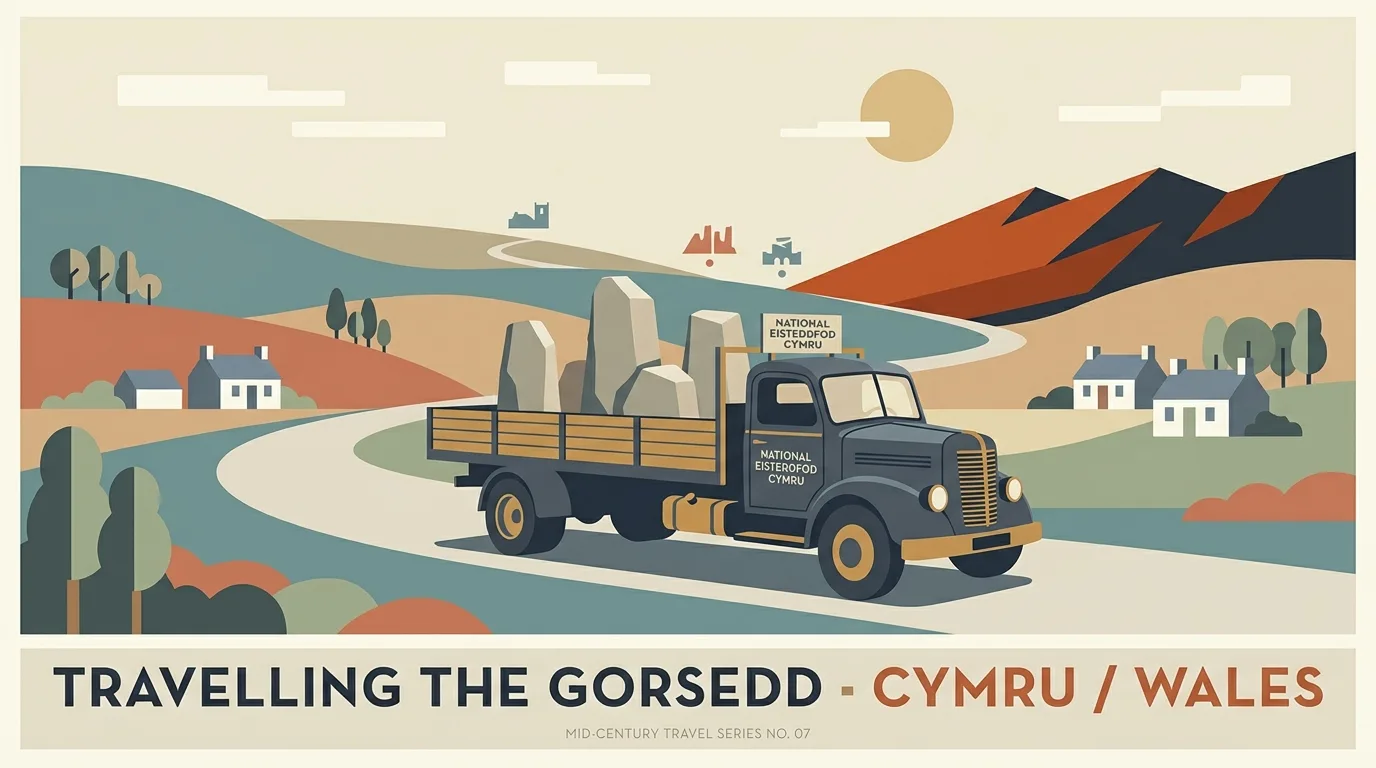
There is one further detail that functions almost as a punchline. In 2005, the Eisteddfod stopped using real standing stones altogether. Permanent circles had been left behind at each venue, multiplying faster than suitable locations existed. The solution was practical: the stones are now lightweight replicas in plastic or fibreglass, transported by lorry from site to site each year.9 The fake ancient stones, replaced by fake stones.
Does It Matter That None of This Is Real?
"Invented tradition" is not a Welsh peculiarity. The Highland clan tartans of Scotland were largely systematized in the early nineteenth century. The English Christmas as most people recognize it is a Victorian construction. The Olympic torch relay was introduced in 1936. Traditions acquire meaning not through age but through use — through the accumulated weight of the people who have practiced them, believed in them, and passed them on.
Former Archdruid T. James Jones, speaking to BBC Wales about Iolo Morganwg, called him a remarkable visionary
whose Wales his contemporaries could not yet see.12
The National Eisteddfod drew 175,000 visitors to Wrexham in 202513 and 186,000 to Pontypridd in 2024.11 These are not people performing an obligation. They are people choosing, in large numbers, to participate in something that matters to them — in Welsh, in Wales, as Welsh.
What those attendance figures don't capture is what it actually feels like to be there. The Eisteddfod is the one week each year when Welsh — a language spoken by roughly 900,000 people, under consistent pressure from English in daily life — becomes the default. Road signs, announcements, conversations in the food queues, arguments about parking: all Welsh. For many attendees, particularly those who grew up speaking it at home and now find themselves code-switching constantly at work, it's described less as a festival and more as a decompression. The white-robed Gorsedd procession crossing the maes — the festival field — draws people out of their tents and away from their pints not because it's solemn, but because it's theirs. A retired teacher from Gwynedd and a software developer from Cardiff and a schoolchild from Rhondda Cynon Taf are all, for that moment, watching the same thing in the same language and feeling the same pull. That the Archdruid's robes were designed by a Victorian painter and the prayer he recites was written by a Regency-era forger is, for most people in that crowd, not the point.
What Iolo understood, perhaps better than anyone of his era, was that Wales in the late eighteenth century was at risk of cultural absorption — its language pressured, its institutions thin, its literary heritage being appropriated or ignored by English scholars. He built a scaffolding of invented antiquity around a cultural identity that was genuinely fragile, and the identity survived. Whether the scaffolding was honest is a separate question from whether the building stands.
Samuel Johnson met Edward Williams in a London bookshop and reportedly told a friend "Today I met Edward Williams. Thank God there's one honest man in London," according to Geraint Bowen's 1993 Cymmrodorion lecture5. Johnson died in 1784, eight years before Primrose Hill. The pebbles came after.
What Iolo understood, perhaps better than anyone of his era, was that a culture under pressure needs something to gather around — something with robes and circles and a question asked out loud before a crowd. It doesn't have to be ancient. It has to be real enough to believe in. Two hundred years later, 175,000 people a year still show up. That's not the legacy of a fraud. That's the legacy of someone who knew exactly what Wales needed.
QHas Wales ever officially acknowledged that the Gorsedd ceremonies were invented?
QDid anyone at the time suspect Iolo Morganwg was forging Welsh history?
QAre there other "invented traditions" at major European cultural festivals that parallel the Gorsedd?
QWhat happened to Iolo Morganwg's forged alphabet, Coelbren y Beirdd?
QCould the Gorsedd be disentangled from the Eisteddfod, now that its origins are known?
Show all 8 wordsShow fewer
Correspondence.