


In Tokyo, a Train That Leaves 25 Seconds Early Is Considered Late
A Japanese rail company once apologized because a train left 25 seconds early.
Not late — early. In Tokyo, a train arriving one minute behind schedule is officially delayed: logged, reported, published monthly for anyone to check. In London that same train would be on time. In New York it would be a miracle.
Tokyo's trains don't run on time because of engineering. They run on time because in Japan, lateness is a form of disrespect.
Why Does a Train Apologize for Leaving Early?
In November 2017, a West Japan Railway train departed its station twenty-five seconds ahead of schedule. No one was injured. No one missed a connection. The company issued a formal public apology anyway.¹
The apology is the data point that matters. The compact isn't just about not being late — it's about the schedule being a promise. Arriving early breaks that promise just as much as arriving late. A passenger who sprinted to the platform and found the train already gone — departed early, technically — would have been failed by the system.
Most transit systems don't think this way. London's Underground allows two minutes before a delay registers officially. New York's MTA considers a train on time if it arrives within five minutes of schedule. Tokyo runs on a different moral standard entirely.
How Did Punctuality Become a Virtue Before It Became a Timetable?
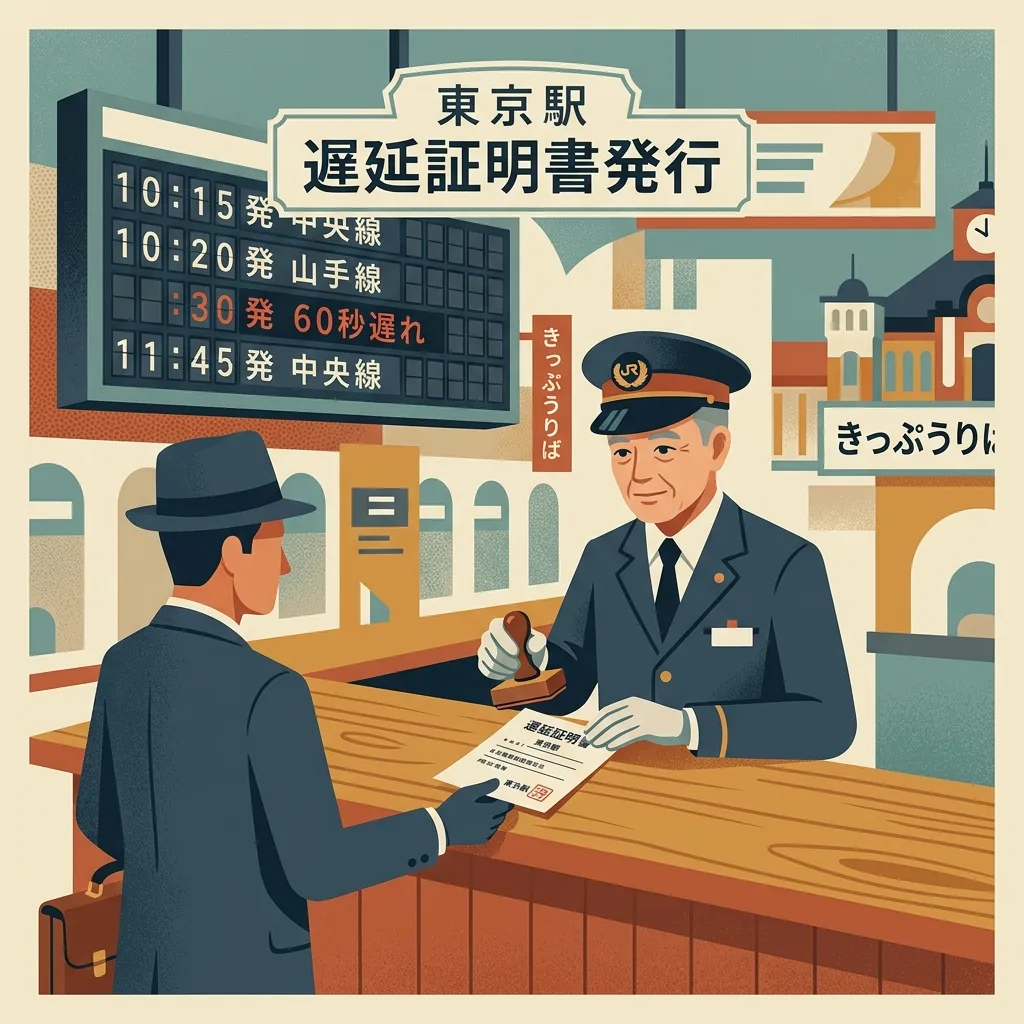
The short answer is: school.
Japanese children are taught punctuality the same way they're taught honesty — as a moral value, not a practical one. It's written into the national curriculum.¹ By the time a Japanese child boards a train for the first time, they already know that being late isn't just inconvenient. It's a form of disrespect to everyone who planned their day around your arrival.
The trains reflect the culture. They didn't create it.
And the culture goes back further than the railways. "The factory whistle came before the train," railway historian Takeshi Abe told The Japan Times. "Punctuality was already a virtue of the modern citizen before rail made it visible."¹ The Meiji era needed synchronized workers before it needed synchronized timetables. The railways just gave that idea its most public, measurable form.
Then the 1964 Tokyo Olympics made it a matter of national pride. The Shinkansen launched weeks before the Games opened. Average delay in its first decade: under one minute per train.¹
For a country rebuilding its identity on the world stage, a bullet train running on time wasn't logistics. It was a statement.
What Does Precision Look Like from the Inside of a Cab?
Every time a JR East driver passes a signal, they point at it. Arm out, finger extended, say it out loud: "Signal, green."
It looks a little odd the first time you see it. It works — the error reduction clocks in at around 85% compared to just looking.¹ Repetition puts your brain on autopilot. Pointing snaps it off.
The Japanese call it shisa kanko. Aviation borrowed it. Surgery borrowed it. Nuclear plants borrowed it. The Tokyo train driver doing it at 6am on the Yamanote Line has no idea he's running one of the most copied safety protocols on earth.
What Does Running 47 Trains at Once Actually Look Like?
Tokyo Metro publishes its timetables to the second. Not the minute — the second. The 2024 Tozai Line lists departures like 07:32:30. Nobody plans their morning around a 30-second window. That's not the point. It's a statement about how seriously the system takes itself.
Station clocks across the city are GPS-synced to match. The obsession goes all the way to the walls.
It has to. During peak hours on the Yamanote Line — the circular line ringing central Tokyo — 47 trains are moving simultaneously, each one two to three minutes behind the last. Think about that for a second: if you stood at any station on that loop during rush hour, another train would arrive before you finished reading this paragraph. One 60-second delay ripples through all 47 within twenty minutes. At that density, precision isn't a cultural preference. It's structural.
Training a JR East driver takes three years. Months on simulators before they're allowed near a live train. Given the math, that makes complete sense.
Where Does the Compact Break Down?
The punctuality story has a few things it tends to leave out.
For one, it's not a national story — it's a Tokyo story. The 60-second standard, the Shinkansen's legendary record, the GPS-synced clocks — that's the urban network. Rural lines in Hokkaido and Shikoku run on entirely different terms, and face ongoing service cuts.¹ "Japan is always on time" is a more accurate statement about the Yamanote Line than about the country.
There's also jinshin jiko — the clinical term Japanese rail operators use for suicides and track accidents. Tragically, this number sits at around 500 to 600 a year,¹ each one inevitably bringing services to a stop. Operators have responded with platform screen doors and warm-toned lighting designed to reduce incidents — quiet interventions that are understandably kept out of the punctuality narrative.
And then there's Amagasaki.
The Cost
April 25, 2005. A JR West train derailed at Amagasaki, killing 107 people.
The driver was 90 seconds late after overshooting a platform and was attempting to make up time. Investigators later found he was also afraid — specifically of nikkin kyoiku, JR West's internal disciplinary program for drivers who caused delays, which by many accounts had become a humiliation mechanism.¹
The same culture that makes trains run on time made a driver push his speed into a curve he couldn't survive. Punctuality, enforced through fear rather than pride, had become something else entirely.
One hundred and seven people lost their lives because a man was terrified of being late.
What Does This All Actually Say About Japan?
There's a theory that the same culture that makes trains run on time also makes it very hard to be different in Japan. That punctuality isn't freely chosen — it's maintained through shame. That the system works because falling short of it carries a social weight most people outside Japan have never felt.¹
Maybe. But listen to how a JR East driver describes his job:
"Every second of delay is something I carry. It's not about the company — it's about the people waiting on the platform who planned their day around my train." — Koji Sato, NHK World¹
Not his KPIs. Not his performance review. The people on the platform.
During the COVID-19 pandemic, passenger volumes on Tokyo's trains dropped by 70%. The revenue case for running on time had largely evaporated. The precision didn't budge.
That's the tell. When a system keeps its values even when nobody's watching, you're not looking at logistics anymore. You're looking at character.
Somewhere between the Meiji factory whistle, the 1964 Olympics, and a million elementary school mornings, Japan made a decision about time. Not that it should be managed. That it should be kept — like a promise, to the strangers standing on the platform who planned their day around a published schedule.
The trains are just where that promise is most visible and measurable.
QCan you actually get a delay certificate from a Tokyo station?
QDoes the 60-second delay standard apply across all of Japan?
QHas any other country adopted shisa kanko?
QWhat happens to a driver who causes a delay?
QWhy don't other countries run trains this precisely?
Show all 4 wordsShow fewer
Correspondence.