


In South Korea, an Apartment Gets More Valuable the Older and More Decrepit It Gets
In South Korea, the brand logo above your apartment gate is worth roughly 100 million KRW — shaping marriage prospects, school access, and generational wealth in ways income alone cannot replicate. A Samsung badge on the gate adds a premium over a comparable unbranded unit in the same location. Same floor plan. Same district. Different name. Different life.
The gate to the Apgujeong Hyundai Apartment complex looks like nobody updated it since the 1980s. Aging concrete pillars, no backlit corporate logo, no gleaming titanium signage. The buildings are the colour of old bone. And yet a square meter inside costs roughly 32 million KRW — comparable to central Paris, for a building constructed before the 1988 Seoul Olympics.1 The parking basement holds a disproportionate number of German sedans. Residents refer to their home not by street or district but simply as "Apgujeong Hyundai." The company name has become the place name.
This is not an edge case. It is the system.
How Did Concrete Become a Class System?
In 1970, apartments made up just 4% of Korea's housing stock while detached houses accounted for 85%. By 2020, that figure had inverted: 62.9% of all South Korean homes are now apartments, according to data from the Architecture and Urban Research Institute cited by The Korea Herald.1 Few comparably dense countries have engineered this transformation in a single generation — and the speed matters, because what happened in fifty years still has the texture of a deliberate project rather than a gradual drift.
The mechanism was a single piece of legislation. The Housing Construction Promotion Act of 1972 simplified administrative procedures for high-rise residential complexes and offered government-backed loans to chaebol — Korea's family-controlled conglomerate groups — conditional on building a minimum unit count, according to the Seoul Metropolitan Government's policy archive2 and an Asian Development Bank Institute working paper on Korean housing policy.3 This fused corporate identity to residential identity from the very first pour of concrete. Hyundai didn't just build apartments. Hyundai was apartments. Samsung followed. So did Lotte, GS, and Daewoo.
French geographer Valérie Gelézeau made the argument, in her landmark study reviewed in East Asian Science, Technology and Society, that most people in Seoul still resist: Korea's apartment monoculture was not a consequence of land scarcity.4 Japan and the Netherlands have comparable population density without becoming apartment-dominant societies. What Korea had instead was a deliberate tripartite alliance — government needed to house a rapidly urbanising population, chaebol needed guaranteed construction volume, and the aspiring middle class wanted an appreciating asset, not just shelter. Apartments were engineered to be owned and to appreciate. They worked.
Why Does the Badge on the Gate Add 100 Million Won?
Walk into any mid-tier apateu danji — the whole residential compound of towers, amenities, security gates, and communal infrastructure — in Mapo-gu on a Tuesday morning. A security guard in a navy jacket checks delivery riders' IDs at the gate. Inside the lobby, a row of shoe racks. Monthly gwallibi — maintenance fees — of 150,000 to 300,000 KRW cover security staffing, landscaping, underground parking. This is not a building. It is a managed social environment.
The name above the gate is, in this market, a service contract — and the price of that contract is already built into the asking price.
Apartments built by Samsung C&T under the Raemian brand — a neologism with no Korean meaning, purely a prestige signifier — command premiums of around 100 million won or more over comparable unbranded units in the same location, according to Korean housing analysts.5 One market intelligence estimate — from a Mordor Intelligence market report — suggests that branded chaebol units trade roughly 25% faster than unbranded equivalents.6 The same floor plan, the same district, the same year of construction — but a Samsung logo reshapes the asking price and the speed at which someone pays it.
When Samsung C&T's Raemian Yongsan Tower opened its subscription lottery in January 2025, 92% of its 850 units reportedly sold within 72 hours — for a building that didn't yet exist, according to a March 2026 Mordor Intelligence market report.6 Buyers were committing to floor plans on a screen because the brand was sufficient collateral.
The premium logic has absorbed other systems entirely. Hakgun — school district catchment zones — are now inseparable from apartment brand. Gangnam families pay hundreds of millions of won more to live within a specific elementary school catchment, itself nested inside a branded danji. The apartment isn't just where you live. It is the infrastructure of your child's educational network.
What Makes an Old Building Worth More Than a New One?
The cruelest mechanism in the system is also the most ingenious: an aging apartment is not a liability. It is a countdown.
Once a complex reaches 30 years old, it becomes eligible for jaegeunchuk — reconstruction. The process involves demolishing the existing buildings and rebuilding to modern specifications, typically with more units at significantly higher prices. A unit in the Dunchon Jugong complex in Gangdong-gu traded at 1.8 billion KRW after reconstruction approval, a 500 million KRW premium above the official sale price, according to Korea Real Estate Board transaction data.7 The moment approval is granted, values surge overnight. The worse condition a building is in, the more it might be worth — because decay is the prerequisite for demolition, and demolition is where the real money is.
The reconstruction eligibility rules have been politically contested for decades — raised to 40 years under one administration, relaxed back to 30 under another, with the Yoon government moving to abolish mandatory safety inspections entirely. The resale value of your apartment depends, in part, on which administration is in office. It is, among other things, a political asset.
This is why the Apgujeong Hyundai complex holds its value not despite its age but partly because of what that age signals. According to accounts circulating in Korean housing communities, when Hyundai Engineering & Construction proposed renaming it "Apgujeong I-Park," residents reportedly refused and forced the company to keep the 1976-era name.8 Whether or not that specific confrontation unfolded as described, the broader fact it illustrates is well-documented: the 1976 name carries more social weight than any modern rebrand could offer. The address had outlived the company's marketing department.
What Happens If You Live on the Wrong Side of the Gate?
Four streets from a branded danji in Mapo-gu: a billa building — four floors, no elevator, stairs that smell of mildew and garlic, a handwritten note about a blocked drain above the mailboxes. The word is a direct borrowing from the Italian and English "villa." In Korean, it means the opposite — a low-rise walk-up with no amenities, no managed security, no chaebol branding. Rent runs 30 to 40% lower than apateu equivalents. The social code is unambiguous: you live here until you can afford not to.
The stigma is not merely cultural. A 2026 peer-reviewed study in Environment and Behavior, using four waves of the Seoul Public Rental Housing Panel Survey, found that perceived housing-based discrimination was associated with reduced trust in others, lower life satisfaction, and stronger NIMBY attitudes toward new public housing developments, as Park, Du & Marçal document.9 The effects were stronger among women.
The Korea Herald documented that public housing residents are called imgar — a compound slur combining "rental housing" and "beggar" — while billa residents are called vilgar.10 The slurs are used against children.
Did you knowIn Korean, the word 'villa' (빌라, billa) — cognate with the Italian luxury term — describes a low-rise walk-up with no elevator and no security. Residents of such buildings have been called vilgar, a compound of 'villa' and 'beggar' — a slur the Korea Herald documented being used against children. (Source: The Korea Herald, October 2021)
A housing preference became a class marker. A class marker became a vocabulary.
What Does It Cost to Get Into the System at All?
Young Koreans who want access to a new branded apartment enter cheongyak: the housing subscription lottery. It begins with opening a dedicated savings account — the jutaek cheongyak jonghap jeochuk — often in their early 20s, making monthly deposits for years to accumulate priority points for a competitive draw for the right to purchase a unit at pre-construction price.
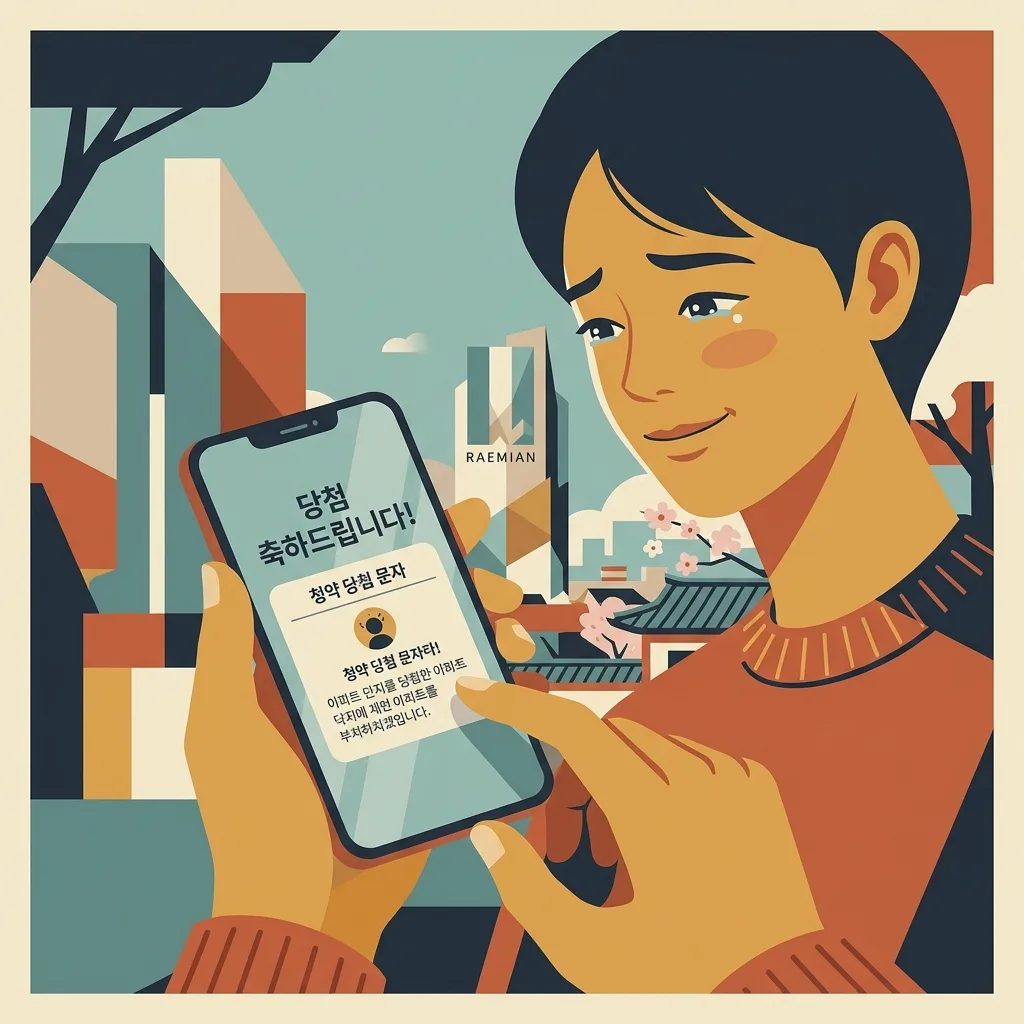
In Seoul's most competitive districts, competition ratios documented in some popular areas have reportedly reached as high as 300:1, even for first-priority holders, according to CoreanLab, a bilingual Korean housing analysis platform.11 When a winner receives the selection SMS, they screenshot it and send it to family group chats immediately. Winning cheongyak is treated as a family milestone — because it is one.
The system rewards long periods of non-ownership and older account holders, which means it systematically disadvantages people in their 30s — the precise demographic trying to form families and buy their first home. Young Koreans coined cheongmu pisa — roughly, "what's the point of subscription?" — an expression of despair at a game whose rules seem designed to exclude the people most urgently trying to play it, as documented in Korean housing commentary collected by NamuWiki's housing subscription entry.12
Myungji Yang's peer-reviewed research in Urban Studies (SAGE, 2018, doi:10.1177/0042098017748092) offers a useful corrective to the idea that this is simply meritocracy at work.13 Many of Gangnam's original middle-class families didn't earn their status through income and then buy apartments — they won apartments in government-subsidised lotteries in the 1970s and 1980s, and then constructed the cultural identity of the Gangnam middle class to justify the status the apartment had already conferred. The hierarchy was built before anyone earned the right to it.
A 1972 law, drafted in urgency, decided that Korean cities would be stratified by chaebol brand. The lottery selected who would climb that hierarchy first. Everyone else has been accumulating points ever since.
The bone-coloured buildings in Apgujeong are still there. The parking basement still holds the German sedans. And the name above the gate — the name residents refused to surrender to a modern rebrand — is still Hyundai.
QDoes the brand of your apartment building actually affect how people treat you socially?
QWhat is the cheongyak system and why is it so contested?
QWhy are older apartment buildings sometimes more valuable than newer ones?
QIs Korea's apartment dominance really about geography, or something else?
QWhat does jeonse have to do with how the apartment economy got built?
Show all 14 wordsShow fewer
Correspondence.