


In Nepal, One Family Has Pierced Their Tongue Every New Year for 108 Years
Every April, a young man in the small Newar town of Bode — east of Kathmandu in Nepal — sits on a wooden chair at the Pancho Ganesh Temple courtyard, opens his mouth, and allows a 10-inch iron needle to pass horizontally through the center of his tongue. He is not a volunteer in any casual sense. He is not performing for a crowd. He is Sujan Bagh Shrestha, and this is what his family does. This is the Jibro Chedne Jatra (tongue-piercing festival), an annual obligation carried out by one family for the entire town.
The Jibro Chedne Jatra — the tongue-piercing festival — is held in Bode, Nepal, on the second day of the Nepali New Year (Baisakh 2).1 Its logic is not spectacle but obligation. A specific family carries a specific duty. The town's safety, in the community's understanding, depends on its continuation.
Why Is One Family Responsible for an Entire Town's Protection?
Bode is a Newar settlement in Bhaktapur district, just east of Kathmandu — a town of roughly 6,364 people, smaller than many urban apartment complexes. The Jibro Chedne Jatra forms part of the Bisket Jatra — the larger Bhaktapur New Year festival complex — but the tongue-piercing component belongs to Bode alone, pegged to Baisakh 2 on the Nepali solar calendar.1
The origin legend anchors the ritual to specific local geography. Evil spirits known as Khyak, emerging from the Nilbarahi forest on Bode's edge, were said to torment the community until a tantric priest prescribed a cure: tongue-piercing would drive them away and protect the harvest.2 The prescription was accepted. It has not been reversed.
What makes the Jibro Chedne Jatra structurally distinct from most ritual practices elsewhere in South Asia is the concentration of responsibility. In Newar society, the Shrestha are traditionally a merchant and administrative caste; in Bode, a specific Shrestha lineage has held the ritual duty for generations, tying spiritual obligation directly to family identity. Only members of this family are eligible.
Within that family, the duty has passed through a clear generational sequence: Sujan's great-uncle Krishna Chandra pierced 12 times; his father Buddha Krishna pierced 9 times; Sujan himself completed his fourth consecutive piercing in April 2026.3 According to Nepali cultural sources, 13 individuals from this family have performed the ritual across approximately 108 years of documented practice — a number that suggests not broad rotation but concentrated, generational inheritance.4
That is not a community sharing a sacred burden. That is a specific bloodline holding it.
What Happens in the Hours Before the Needle Enters
The preparation begins three days before Baisakh 2.
The piercer observes a strict water-only fast. He cannot touch women, or anyone in a state of ritual impurity. He cannot eat salt. He cannot leave Bode. These restrictions are not incidental — they transform the individual into a ritual vessel, emptied of ordinary life so that something else can move through him.1 For someone living in a town where work and family life intertwine on narrow brick-paved streets, the isolation is not theoretical. It means three days of near-complete social separation, conducted in the full knowledge of everyone around you.
The needle itself undergoes parallel preparation. The 25-centimeter iron rod is soaked in mustard oil for several days before the ceremony and coated with a metal primer to reduce rust — a detail that sits somewhere between practical precaution and ceremonial specificity, the two categories blurring together as they often do in living ritual traditions.1
On the morning of Baisakh 2, thousands gather in the Pancho Ganesh Temple courtyard. Incense and mustard oil mix in the air. The piercer sits in a white turban on a simple wooden chair. A ritual specialist performs the piercing — the needle passes through the tongue's center. There is reportedly minimal blood. Once in place, a small lamp is hung from the needle's exposed end.
Then the piercer stands up.
He shoulders a crescent-shaped brass lamp — the mahadip — about 18 inches across, and begins walking. The route covers roughly 2 kilometers through Bode's narrow streets, past two-story Newar houses with carved wooden windows, encircling the town's perimeter. A flame hangs from his tongue. Another burns on his shoulder. The procession takes approximately three hours.
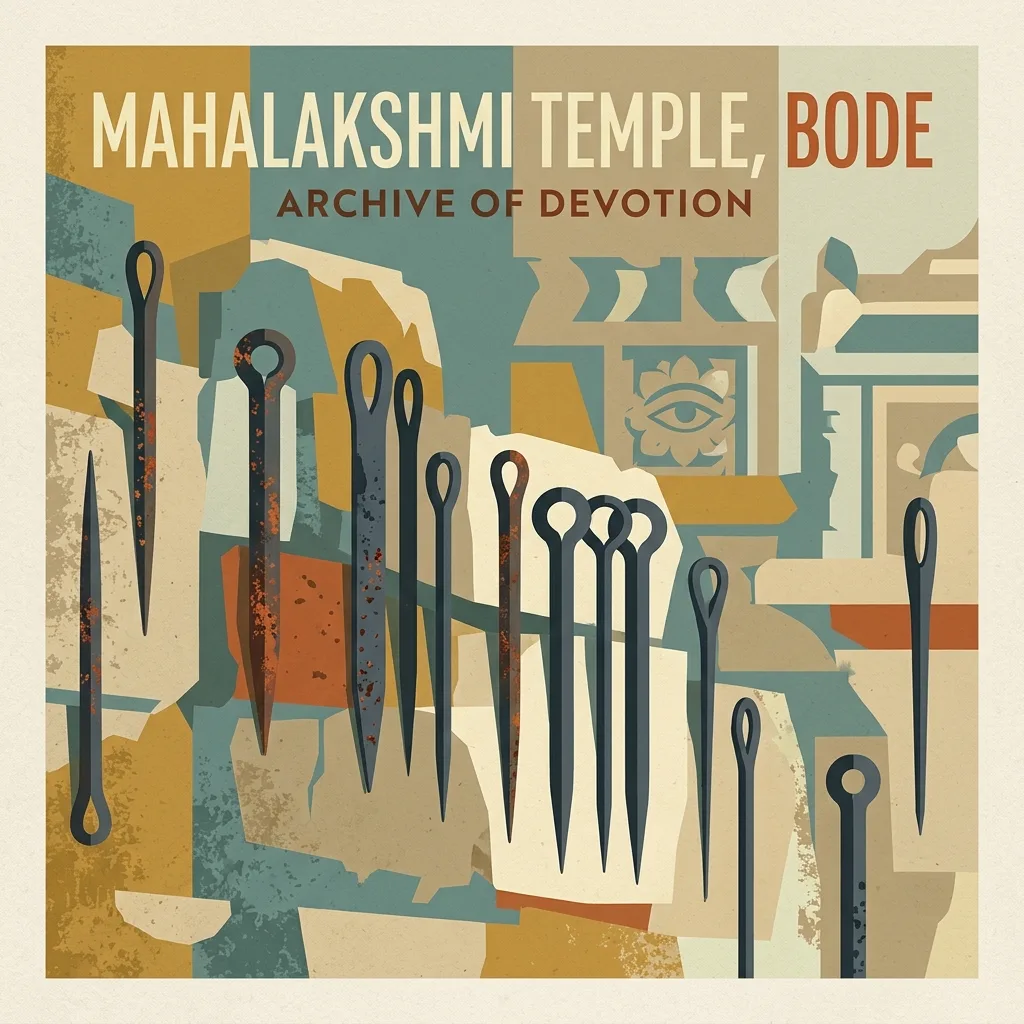
At the Mahalakshmi Temple, after full circumambulation, the needle is removed. Temple priests apply soil from inside the Mahalakshmi's walls to the wound — soil believed to carry healing properties. The used needle is then pressed into the temple wall alongside dozens of others from previous years, each one a completed obligation, a year the town was protected.
What Gets Tested When the Ritual Breaks Down
The Jibro Chedne Jatra has been interrupted twice in living memory.
The first interruption lasted 11 years, caused by financial problems — the festival's costs proved beyond the community's means for over a decade. The community experienced this not as an inconvenience but as an ominous gap, a period during which Bode was exposed to the forces the ritual was believed to protect against: the crop-destroying spirits, the harvest threats, the Khyak returning from the Nilbarahi forest.5 The second interruption came in 2020 and 2021, when COVID-19 made the gathering impossible. Both interruptions generated genuine community anxiety — not abstract worry, but the specific fear that comes from believing cause and effect are directly linked.5
Buddha Krishna Shrestha — Sujan's father, who pierced his own tongue nine times — described the COVID interruption through that lens directly. He had been driving ambulances and serving patients through the pandemic, then resumed the tongue-piercing when it became possible, treating both as forms of the same service.6
He told Annapurna Post: Having been engaged in humanitarian service and cultural preservation, I could not pierce last year due to COVID — this year on Baisakh 2, I have decided to pierce for the eighth time and continue the festival
.6
The comparison is not casual. For the Shrestha family, community service and ritual duty are not separate categories.
What Changes When the Government Starts Paying
In April 2026, the Bagmati provincial government awarded Sujan Bagh Shrestha 200,000 NPR7 — approximately $1,500 — formalizing a centuries-old family duty as a state-recognized act of cultural preservation. Multiple Nepali news sources confirm the payment was made in 2026.
Even as a single gesture, its significance is structural. What had been an obligation maintained by one family through community expectation and personal faith now has a line item in a provincial cultural budget. The ritual has been acknowledged by the state as something worth preserving financially, not merely tolerating administratively.
This changes the economics without, apparently, changing the intent. Sujan is still in his late twenties. He still fasts. He still accepts the needle. But the provincial government of Bagmati has now decided that someone should be paid for this.
The needle pressed into the Mahalakshmi Temple wall this April joins dozens of predecessors. It does not know about the check.
QHas any Shrestha family member ever refused the duty, and what happened?
QDoes the tongue heal fully after each piercing, given that Sujan has done this four consecutive years?
QAre there other tongue-piercing traditions in the same region, or is Bode unique?
QWhat happens to the mahadip — the crescent lamp — after the procession?
QCould the provincial government award eventually attract participants from outside the Shrestha family, diluting the hereditary nature of the tradition?
Show all 11 wordsShow fewer
Correspondence.