


Istanbul Plants 30 Million Tulips a Year — and Almost Nobody Knows Why
Every April, Istanbul plants approximately 30 million flowering bulbs — mostly tulips, but also hyacinths and daffodils — across its parks, roundabouts, and public squares. Not as decoration, but as an act of imperial memory so old and so layered that the city itself may no longer fully understand what it's doing.
The flower is called lale in Turkish. It always has been. And for five centuries, the lale was not simply a cultivated plant — it was an Ottoman state symbol, a theological cipher, a measure of social rank, and eventually the thing a revolution came to destroy. The annual April planting is, intentionally or not, a re-coronation.
Why Did a Flower Become Sacred Before It Became Beautiful?
The answer, according to the most widely accepted account, is in the alphabet — and in a 470-year-old miscommunication involving the word tülbent, the Ottoman Turkish word for turban.
In the abjad system of Islamic numerology, each Arabic letter carries a numerical value. The letters that spell lale add up to the same numerical value as the letters that spell Allah — a coincidence that Ottoman mystics interpreted as divine signature. Those letters, rearranged, also approximate the spelling of hilal, the crescent moon: the symbol of the Islamic world.
Islamic Arts Magazine traces the lale's standing as an object of spiritual meditation directly to that numerical coincidence: the flower is humble, the magazine notes, because in bloom it bows its head before the majesty of God
.1
Ottoman court culture didn't invent this symbolism — it discovered it, and then spent three centuries building an empire's iconography around the find. The dagger-shaped petals of the Ottoman-preferred tulip — long, pointed, nothing like the round Dutch cup that eventually dominated global taste — appear on Iznik ceramic tiles across Istanbul. The Rüstem Pasha Mosque near the Spice Bazaar is blanketed in roughly 2,300 tiles across 80 patterns, covering every surface including the porch façade, according to Islamic Arts Magazine. At the Topkapı Palace gate, the Sultan Ahmed III Fountain (1728) is inscribed with the sultan's own poem — surrounded, of course, by carved tulips.1
What Made an Entire Era Take the Flower's Name?
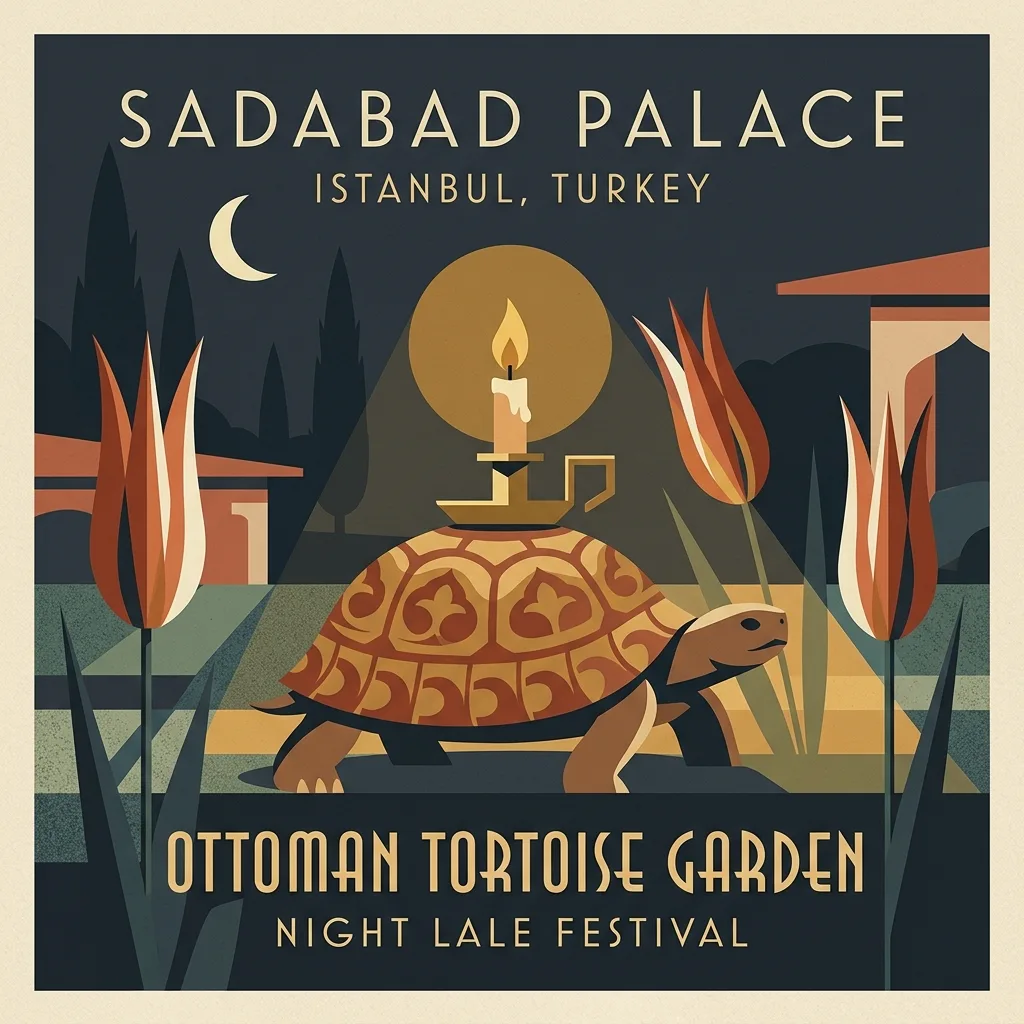
In 1718, following military catastrophe — the Ottomans had lost Hungary to the Habsburgs — Sultan Ahmed III and his Grand Vizier Damat Ibrahim Pasha made a deliberate choice to reframe the empire around culture rather than conquest. Peace, art, gardens. The result was the Lâle Devri: the Tulip Era, 1718–1730.
It was the only named period in Ottoman history where a flower, not a battle or a dynasty, gave its name to an epoch. That name was coined retroactively by early 20th-century historian Ahmed Refik Altınay — historians Cemal Kafadar and Can Erimtan have since argued the "Tulip Period" is partly a historiographical construct, a frame imposed backwards onto an era contemporaries would have described differently.2 The framing stuck anyway, which says something about the power of the symbol.
At the era's height, Ottoman grandees were ranked not by military achievement but by horticultural accomplishment. Court painter Abdülcelil Levni's albums assigned social distinction based on what tulip varieties a man had cultivated.3 The Sadâbâd Palace on the Golden Horn became the center of a culture so elaborate it required its own vocabulary.
Ahmed III's spring parties had a name: Çırağan Sefaları — Lantern Entertainments. The gardens were planted in geometric and calligraphic patterns, each variety labelled in silver filigree. Cut stems were propped in glass bottles to fill any gaps. Mirrors were positioned to multiply everything. Every fourth flower had a candle set into the earth at tulip height. Then, as night fell, hundreds of tortoises with candles fixed to their shells were released into the beds — slow-moving lanterns, their wandering creating drifting pools of light across the petals.2 Songbirds hung in gilded cages. Guests dressed in colors chosen to flatter specific blooms. At the signal of a cannon, the harem doors opened.
The Topkapı Palace Museum's own archive confirms the lantern processions called 'Çırağan Sefaları'
and the candles set into the backs of tortoises — the era's pursuit of fantasy and aesthetics, in the museum's words.4
This repeated every night for the duration of the tulip bloom.
How Does a Flower Party End an Empire?
On September 28, 1730, it ended in four days.
The Patrona Halil Rebellion — named for an Albanian bathhouse attendant and former Janissary named Patrona Halil — brought 12,000 followers into the streets of Istanbul. They burned the Sadabad Palace to the ground. Grand Vizier Ibrahim Pasha was executed, his body paraded through the city. Sultan Ahmed III abdicated.5
The tulip gardens were specific targets. The rebels understood them as what they were: symbols of elite indulgence while the empire contracted militarily and taxes rose.
Scholars at the History of Istanbul project note that the rebellion's roots lay in military defeat against Persia, new taxation, factional power struggles, and guild discontent — not merely the garden parties.6 The tulip-as-cause narrative is partly a historiographical seduction: the symbolism is too clean to resist. The gardens were a target, not a trigger. The distinction matters.
What isn't in dispute: the mob knew which gardens to burn.
What Does This Have to Do With 30 Million Bulbs in 2026?
The İstanbul Lale Festivali was inaugurated in 2006 by the Istanbul Metropolitan Municipality. Reading Apollo Magazine's 2017 analysis of neo-Ottomanism, the 2006 festival timing looks less like civic horticulture and more like a deliberate political act — the AKP government, which came to power in 2002, began deploying Ottoman heritage imagery across architecture, fashion, public ceremony, and urban space. The tulip festival is the floral branch of a much larger political project — and following the 2025 arrest of Istanbul Mayor Ekrem İmamoğlu and the protests that followed, the municipality's Ottoman-revival programs have become contested terrain between the central government and the city's opposition.7
The 30 million figure deserves a gloss: it counts all bulbous plants planted citywide across the full April season — tulips, hyacinths, daffodils — across roundabouts, medians, parks, and pedestrian underpasses throughout Istanbul. The 2025 İBB — Istanbul Metropolitan Municipality — confirmed 7.78 million tulips specifically for the Lale Bayrami event at Emirgan and the major festival venues.8 Both numbers are real; they measure different things. The citywide figure is the one that captures the ambition.
Emirgan Park — the main festival venue, 117 acres on a Bosphorus hillside enclosed by high walls — was itself a former private Ottoman imperial estate. Sultan Murad IV gave it to a Persian commander in the 17th century. The exiled Khedive of Egypt owned it in the 19th. It was donated to the city only in the 1940s.9 The most public celebration in Istanbul takes place on land that was never originally meant to be public at all.
The bulbs come mostly from Konya, nearly 1,000 kilometers away — grown by private farmers on contract to the municipality, transported to Istanbul in late March, planted in late autumn for spring bloom.10 An ancient imperial gesture, rebuilt as a modern agricultural supply chain.
There's one more layer. After the fall of the Ottoman Empire, Turkey spent decades sourcing tulip bulbs from Dutch suppliers — the country that had absorbed the flower into its own national identity so completely that its Ottoman origins were largely forgotten. Europe's first tulips bloomed in Augsburg in 1559, where Swiss botanist Conrad Gesner named them tulipa turcarum — Turkish tulip, according to Daily Sabah's 2021 article on the flower's history. Within two generations, they were simply Dutch.11 The festival can be read, in part, as an act of botanical repatriation — a country buying back, in bulbs and in meaning, the symbol it had given away.
Does Istanbul Know What It's Celebrating?
According to the Istanbul Metropolitan Municipality, the tulip carpet in Sultanahmet — 700,000 flowers woven into a traditional rug pattern in front of the Blue Mosque, covering 1,400 square meters — takes teams from Konya two and a half days to plant, flower by flower. The hyacinth smell arrives before the color does. The pattern is recognizable from the Iznik tiles inside the mosque behind it, from the carved fountain at the Topkapı gate, from the miniature paintings in the palace archives. The flower has not changed. The city has simply kept doing what it was taught to do.
The annual planting has outlasted its original meaning — but that is how symbols work. They persist after the politics that made them have rotted away. What remains is 30 million flowers opening in April along the Bosphorus, in parks that emperors once walled off for themselves, planted by workers from a city 1,000 kilometers away, in a country that had to buy its own symbol back from Europe.
The lale bows its head in bloom. It always has.
QWhat is the Istanbul Tulip Festival and when does it take place?
QWhy is the tulip such an important symbol in Turkish and Ottoman culture?
QDid the word "tulip" really come from a miscommunication?
QIs the Istanbul Tulip Festival a political event?
QHow many tulips does Istanbul actually plant for the festival?
Show all 9 wordsShow fewer
Correspondence.