

UK Bank Holidays Are a Regulatory Trick, Not a Legal Right
The British bank holiday is not a workers' right. It never was. It's a piece of financial regulation — passed in 1871 to close banks, which forced the rest of commerce to follow — and most of the people who enjoy it today have no statutory entitlement to it whatsoever.
That sleight of hand is the whole story.
How Do You Give a Nation a Day Off Without Fighting for It?
You don't call it a holiday. You call it a banking regulation.
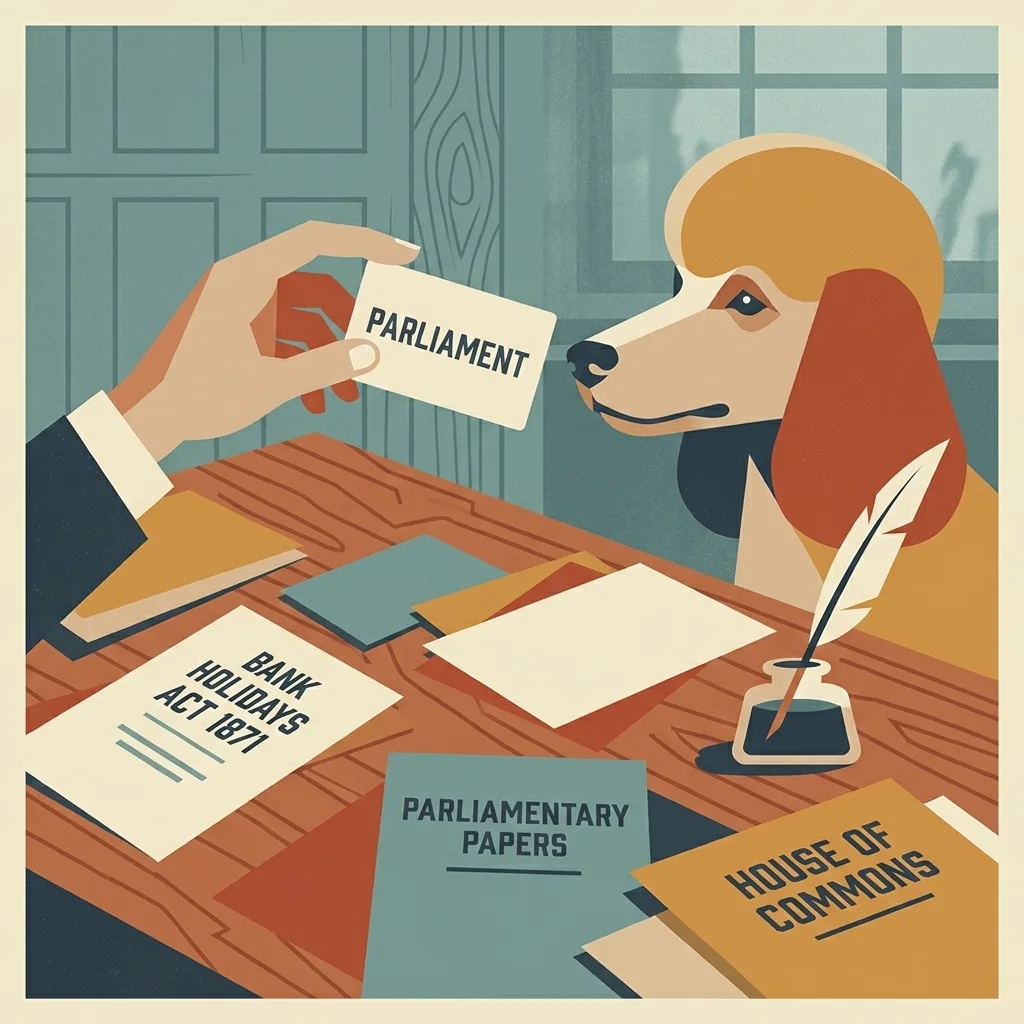
When Sir John Lubbock introduced the Bank Holidays Act 1871 to Parliament, he framed it as financial housekeeping — a technical measure governing when banks could legally close. Not a workers' rights bill. Not state-mandated leisure. The distinction was deliberate. A bill explicitly granting workers rest would have triggered what reformers privately feared: a moral panic about idleness, state overreach, and the unravelling of Victorian industry. Framing it as financial regulation1 sidestepped the fight entirely.
Close the banks, and commerce stops anyway. Holiday achieved. No one can accuse you of legislating for leisure if you've only legislated for banking.
The Act designated four days for England and Wales — Easter Monday, Whit Monday, the first Monday in August, and Boxing Day — and different days for Scotland, where the cultural weight of Hogmanay — the Scottish New Year's Eve celebration, of probable Norse or French origin, meant New Year's Day mattered more than Boxing Day.2 The law encoded cultural difference between the nations from day one. It has never fully reconciled them since.
What Had Already Been Taken Away Before Lubbock Gave Anything Back?
The framing of 1871 as a gift depends on forgetting what came before.
Before 1834, the Bank of England's Threadneedle Street headquarters closed for approximately 33 to 40 days a year — saints' days, royal anniversaries, religious festivals, and such obscure occasions as the Anniversary of the Execution of Charles I.1 Industrial pressure reduced this to 18 closures in 1830. By 1834, the list had been cut to four: May Day, All Saints' Day, Good Friday, and Christmas. In roughly four years, financial workers lost nearly a month of rest.3
Lubbock's Act, hailed as progress, was partial compensation for a prior stripping. Industrial capitalism had taken the calendar apart. Parliament reassembled a smaller version of it and called the result reform.
This reframing matters because the 1871 Act has a persistent reputation as a gift from a benevolent banker to a grateful working class. But working-class people had already made their own holidays, decades before Parliament noticed.
The custom was called Saint Monday — the informal practice of artisans and labourers simply not turning up on Mondays, treating the day as an extension of Sunday rest. Labour historian Keith Flett, citing the Chartist Northern Star, records that Easter Monday in London in 1850 was described as the great holiday of the labouring classes
.4
Workshops "comparatively empty," places of amusement "inordinately full" — twenty-one years before Lubbock's Act.5 Workers had already claimed the time. Parliament legitimised it, regularised it, and — not incidentally — handed employers a tool to contain it within a predictable calendar.
The bank holiday wasn't given to working people. It was taken from what they were already doing and put in a box with a lid.
Who Was Actually Benefiting Here?
Not everyone equally, and this was apparent almost immediately.
The Act was designed for salaried bank clerks and office workers — people whose wages kept flowing whether or not they showed up on a given Monday. When a proposal to extend the Act came before Parliament in 1875, an MP rose to speak on behalf of 40,000 Durham colliery workers who actively opposed it. The argument, recorded verbatim in Hansard, was blunt: daily-wage labourers were paid by the day, not the year. Forced closure meant no coal moved, no work happened, no wages paid. Rest without pay was not liberation — it was poverty.4
On the first August bank holiday — 4 August 1871, the date that genuinely felt new, since Whit Monday was already customary — banks and warehouses in Manchester closed. Cotton mills stayed open. Uneven from the first day it existed.
The reception in London, though, was extraordinary. Four times the usual number of trains departed for the Kent coast towns of Margate, Ramsgate, and Dover.6 Middle-class observers who had feared collective leisure would produce disorder were reassured. Reynolds's Newspaper reported in August 1871 that the day had produced not a tipsy or ill-conducted person
.2
The anxious note in that observation is worth sitting with. The fear wasn't logistical. It was moral. Could working people be trusted with unscheduled time? The answer, apparently, was yes. Lubbock wrote in his diary that "every seaside place near London, every railway and place of amusement was chock-full."7 The days were immediately nicknamed St Lubbock's Days in the newspapers — a quasi-saintly honour for a man who was simultaneously a Liberal MP, a banker, an archaeologist who had coined the words "Palaeolithic" and "Neolithic" in his 1865 book Pre-historic Times, Charles Darwin's next-door neighbour, and — by one widely reported account — reportedly attempted to teach his poodle to read flash cards.8
The man who invented the British long weekend was one of the more improbable figures in Victorian public life. The bank holiday was almost a side project.
Why Doesn't Anyone Know It Was Never Actually a Right?
Because it works. And because the fiction has been running for 150 years.
There is no statutory entitlement in UK law for employees to take bank holidays as paid days off. Employers can legally require staff to work Christmas Day. More specifically: employers can count bank holidays against a worker's 28-day minimum annual leave entitlement — meaning a contract that says "20 days plus bank holidays" is not offering a benefit above the legal minimum. It is the legal minimum, distributed differently.9 Lewis Silkin's April 2026 employment law guidance confirms the position remains unchanged.
The UK is unusual in Europe in permitting this arrangement. Most EU countries treat public holidays as guaranteed paid days on top of annual leave minimums10 — the bank holiday sits outside and above the annual leave pot, not inside it. England and Wales have 8 bank holidays per year, the lowest figure in Europe by comparative analysis. The TUC, citing an EU average of 12.8 days, renewed its call in November 2025 for four additional holidays, describing the current entitlement flatly as "stingy."11
Then there is the colonial inversion. India observes 21 public holidays (though this varies by state and religion). Japan 17. Australia 12. New Zealand 11.12 The country that invented the statutory bank holiday as a modern institution, and exported the framework across an empire, now ranks below almost every country it once governed. Former colonies took the structure and added to it. Britain kept the structure and left it where it was.
What Does the Calendar Know That Workers Don't?
The 1971 Banking and Financial Dealings Act, which replaced and updated the 1871 legislation, made one significant quiet decision: it severed Whit Monday from its religious meaning — Pentecost Sunday — and replaced it with a secular Spring Bank Holiday on the last Monday of May. A Christian observance became a scheduling convenience. The calendar was being secularised, without announcement, without debate.13
But secularisation was not universal. Northern Ireland retains 10 bank holidays — more than anywhere else in the UK — including Orangemen's Day on 12 July. The holiday commemorates the Battle of the Boyne in 1690, when the Protestant King William III defeated the Catholic King James II. Proclaimed an official bank holiday by the Governor of Northern Ireland in 1926, it remains state-sanctioned today.13 A day that functions as celebration for one community and political provocation for another sits in the work calendar — paid for by the state — because of decisions made a century ago about which history deserved commemoration.
In Gibraltar, Commonwealth Day — formerly Empire Day, marked on Queen Victoria's birthday — was an official public holiday until 2022, when it was quietly renamed the Winter Midterm Bank Holiday.10 The imperial occasion didn't disappear. It was laundered into a secular calendar slot. The date remains. The origin is no longer visible.
This is how the bank holiday works, in the end. Not by preserving history explicitly, but by absorbing it into structure — encoding past compromises, past politics, and past power arrangements into the rhythm of the working week, where most people experience them as neutral, natural, and inevitable.
Lubbock's regulatory sleight of hand in 1871 turned out to have a very long run.
QIs there actually no legal right to take bank holidays off in the UK?
QWhy does Scotland have different bank holidays to England?
QWhy is it called a "bank holiday" rather than a "public holiday"?
QHas Parliament ever added a one-off bank holiday for a specific event?
QWhy do former British colonies now have more public holidays than the UK itself?
Show all 4 wordsShow fewer
Correspondence.