


In Finland, Drinking Alone in Your Underwear is Endorsed by the Government
Kalsarikännit — drinking at home alone in your underwear with no intention of going out — is so embedded in Finnish culture that the country's Ministry for Foreign Affairs built an official emoji around it, launched it in 13 languages as part of a national branding campaign, and watched over 2,000 media outlets pick up the story. Finland has ranked as the world's happiest country for nine consecutive years. Both facts flow from the same cultural permission: the freedom to be alone without shame.
What Does It Mean That a Foreign Ministry Made This?
The Finnish Ministry for Foreign Affairs handles treaties, diplomatic relations, and consular affairs. In December 2015, it also designed an emoji of a man drinking alone in his underwear — white briefs, gray armchair, eyes closed in serene self-satisfaction.1
That emoji — and its companion, a woman in a lavender nightgown cradling a glass of red wine — launched as part of a set of 56 country-themed emojis, the first any government had ever published.2 The campaign ran through ThisisFINLAND, the ministry's official country-brand website, revealing one emoji per day through an advent calendar in 13 languages including Arabic, Hindi, and Japanese. The kalsarikännit emoji was freely downloadable from the official government image bank. It still is.
Petra Theman, then Director of Public Diplomacy at the ministry, described how it happened. The Finland emojis were a brainwave that got out of hand!
3 The brainwave came from her unit — not from a tourism board or an independent agency, but from the department responsible for how Finland presents itself to the world. The emoji was designed by Art Director Bruno Leo Ribeiro of agency hasan & partners, working to a brief that took kalsarikännit seriously as a cultural export.
Why kalsarikännit specifically? In 2015, a German website declared it the most beautiful word in the world, noting that German required nine words — sich allein zu Hause in Unterhosen betrinken — to convey what Finnish compressed into one.4 That linguistic gap caught attention, contributed to the word's European cultural moment, and caught the eye of Theman's team. According to Theman, we chose to create an emoji of kalsarikännit because it achieved prominence in the German language conversation in 2015. They turned out cute. It's a successful emoji.
5
Over 2,000 media outlets worldwide — including CNN, BBC, and the Chicago Tribune — covered the launch.5 A man in his underwear drinking a beer had become Finnish foreign policy.
Why Does Finnish Have a Word for This at All?
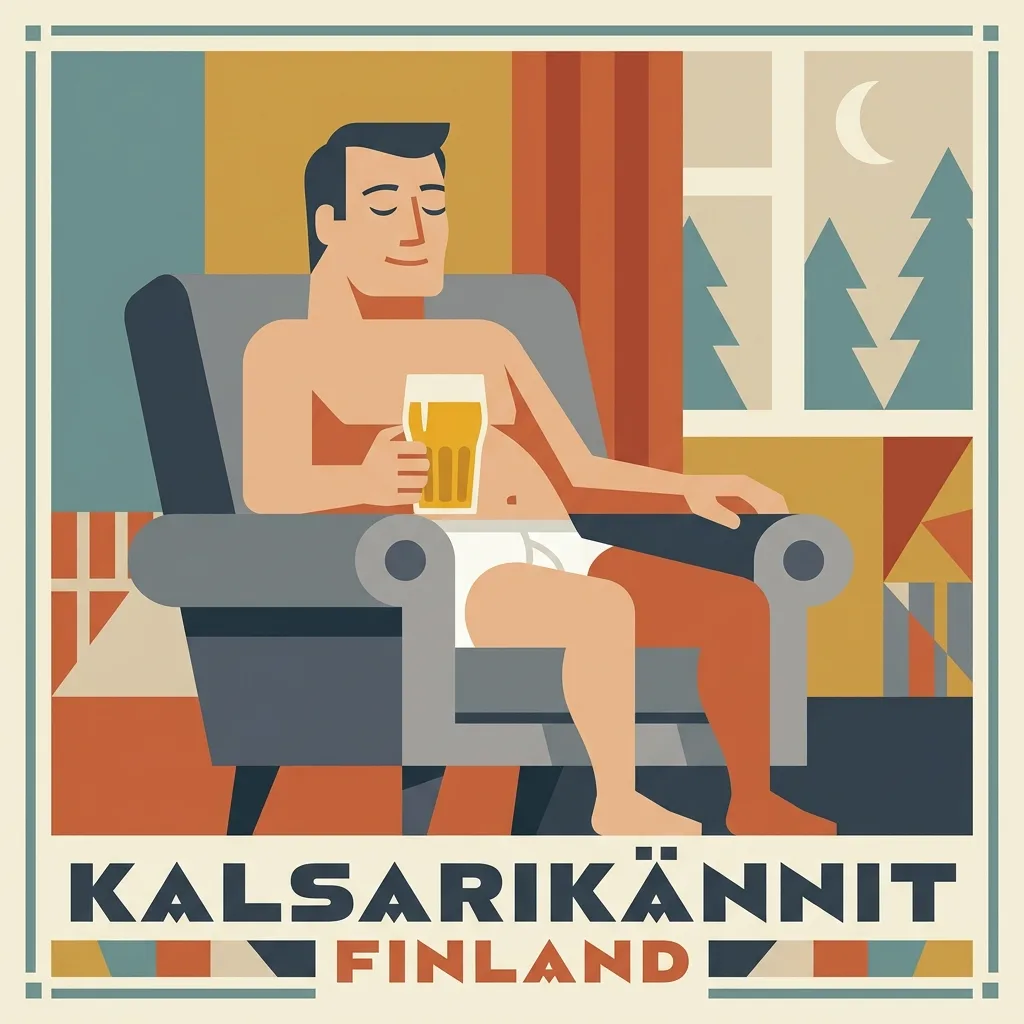
Kalsarikännit compounds kalsarit — underwear — and kännit — a casual word for tipsy or drunk. The word was already in circulation long before the emoji arrived. Finns tend to name things precisely. The language routinely creates compound words for experiences other languages handle with circumlocutions or just don't bother naming.
The concept makes obvious sense in Finnish conditions. In the south, winter daylight shrinks to around six hours. In the north, it disappears entirely for weeks. Temperatures regularly drop to -20°C. Going out in those conditions requires real motivation — the kind that, on a Friday night in January, you may simply not have. Staying in, getting comfortable, and opening a beer isn't laziness. It's climatically rational behavior that has been happening for generations. The word just gives it its due.
Miska Rantanen, a journalist at Helsingin Sanomat, Finland's largest newspaper, noticed that the international wellness conversation — Danish hygge, Swedish lagom — had never really included Finland. His 2018 book, Pantsdrunk: The Finnish Path to Relaxation, published by HarperCollins, proposed kalsarikännit as Finland's answer: a philosophy of radical permission to be alone, underdressed, and unbothered.6 One of the world's five largest publishers put serious effort into marketing the idea that getting drunk in your underwear could function as legitimate self-care. The book was translated internationally.
Fins themselves often point out that the alcohol is almost incidental. The real content of kalsarikännit is the absence of social obligation — no plans, no performance, no one to be for.
What the Data Actually Shows
A 2022 peer-reviewed study published in Addiction by researchers Mäkelä, Kumpulainen, Härkönen, and Lintonen tracked Finnish drinking occasions across the 2000s and found a consistent, measurable shift toward home drinking — what the researchers called the "domestication" of alcohol consumption.7 Drinking at home, alone, had grown as a proportion of total Finnish alcohol consumption over two decades. The study gave a name to something Finns already knew experientially.
The THL — Finland's national Institute for Health and Welfare — reported in 2024 that alcohol consumption had continued its long-term decline, falling to around 8.7 litres per capita in 2023, down from a 2007 peak of 12.7 litres.8 But the same report noted that 23% of adults aged 20-79 — approximately 940,000 people — still drink five or more units in a single sitting at least monthly. Alcohol is most typically consumed at home and on weekends.
Finland is drinking less than it used to. But when it drinks, it often drinks a lot, and it does so at home. Kalsarikännit as a cultural practice exists on a spectrum that runs from a quiet beer on a Friday evening to something more concerning.
Pia Mäkelä, a research professor at THL, has noted that around three quarters of all alcohol consumed in Finland goes down either in binge drinking situations or by consumers already exceeding the limits of risky drinking.8 The wellness-export framing of kalsarikännit — cozy, self-care, a Finnish path to relaxation — sits alongside that number. Both are true. The Ministry for Foreign Affairs knows this. Its public diplomacy unit created the emoji with a tongue firmly in cheek. The Ministry of Social Affairs and Health, through THL, runs simultaneous campaigns aimed at reducing alcohol harm. Two arms of the same government, working toward different communicative ends. Theman herself acknowledged the duality: the branding needed to reflect the real country, complications included.
Why Finland Ranks as the Happiest Country on Earth
Finland has ranked first in the World Happiness Report for nine consecutive years, from 2018 through 2026.9 The report uses Gallup World Poll data across 143 countries, measuring life evaluations against social support, income, health, freedom, generosity, and corruption. Finland wins, consistently, by significant margins.
The easy joke writes itself: the happiest country in the world promotes drinking alone in underwear as a national pastime. But the relationship is more interesting than ironic.
Finnish happiness research points repeatedly to social trust, institutional reliability, and freedom from social pressure as core drivers. Finns report high confidence that someone would help them if they lost their wallet. They report high satisfaction with government services. And they report — implicitly, through the kalsarikännit concept — a high tolerance for being alone without that aloneness feeling like failure.
That last point matters. In many cultures, staying home on a Friday night carries social stigma. In Finland, there is a word for it that is warm, specific, and widely shared. The cultural permission to be solitary and comfortable without apology may be genuinely connected to wellbeing in ways that are harder to quantify than GDP. When the Ministry for Foreign Affairs chose this word to represent Finland to the world, it understood that. Kalsarikännit isn't embarrassing to Finns. It's accurate. The emoji is just the country admitting it out loud.
QHas any country tried to copy Finland's emoji nation-branding strategy?
QIs kalsarikännit related to Finnish sisu?
QDoes Finland have any formal policies around solitary drinking that other countries lack?
QWhat happened to the German "Word of the Year" claim — was kalsarikännit actually the winner?
QIf drinking is declining in Finland, does kalsarikännit still describe actual behavior?
Show all 7 wordsShow fewer
Correspondence.