

In Madagascar, Families Dig Up Their Dead Every Few Years to Dance With Them
The dead are not gone in Madagascar. They're just not ready yet.
Famadihana — the "turning of the bones" — is the ceremonial exhumation, rewrapping, and celebration of family ancestors practiced by the Merina and Betsileo peoples of Madagascar's central highlands. Every five to seven years, families open their tombs, carry their dead into the light, and dance with them. Not out of grief. Out of obligation, love, and the absolute conviction that the people inside those tombs can still hear you.
Why Does This Happen Every Few Years Rather Than Once?
The answer lies in the Malagasy understanding of what death actually is — and when it ends.
In Merina and Betsileo cosmology, the razana — ancestors who function not as memories but as active spiritual forces mediating between the living and the divine — don't fully enter the ancestral realm until their body has completely decomposed.1 The physical remains are, in a real sense, still in transition. Famadihana assists this process: the fresh lamba mena, the silk shroud woven from wild Borocera silk — a textile produced by silkworms endemic to Madagascar, found nowhere else on earth, accelerates the journey by replacing the rotting cloth the body has been lying in.2
This is not a morbid curiosity. It is a coherent theology. The ritual isn't about refusing to let go — it's about understanding that departure takes time, and that the living have responsibilities to the departing.
The timing follows a logic of its own. The ceremony is held at odd-year intervals — three, five, seven, nine, sometimes eleven years — and always during the dry season between July and September, when the red laterite soil of the highlands is firm enough to open without flooding and the rice paddies lie fallow.3 A soothsayer, the mpanandro, determines the exact auspicious date. No family schedules a famadihana on a whim.
The invitation, though, doesn't come from the living.
How Do You Know When to Dig Up Your Ancestor?
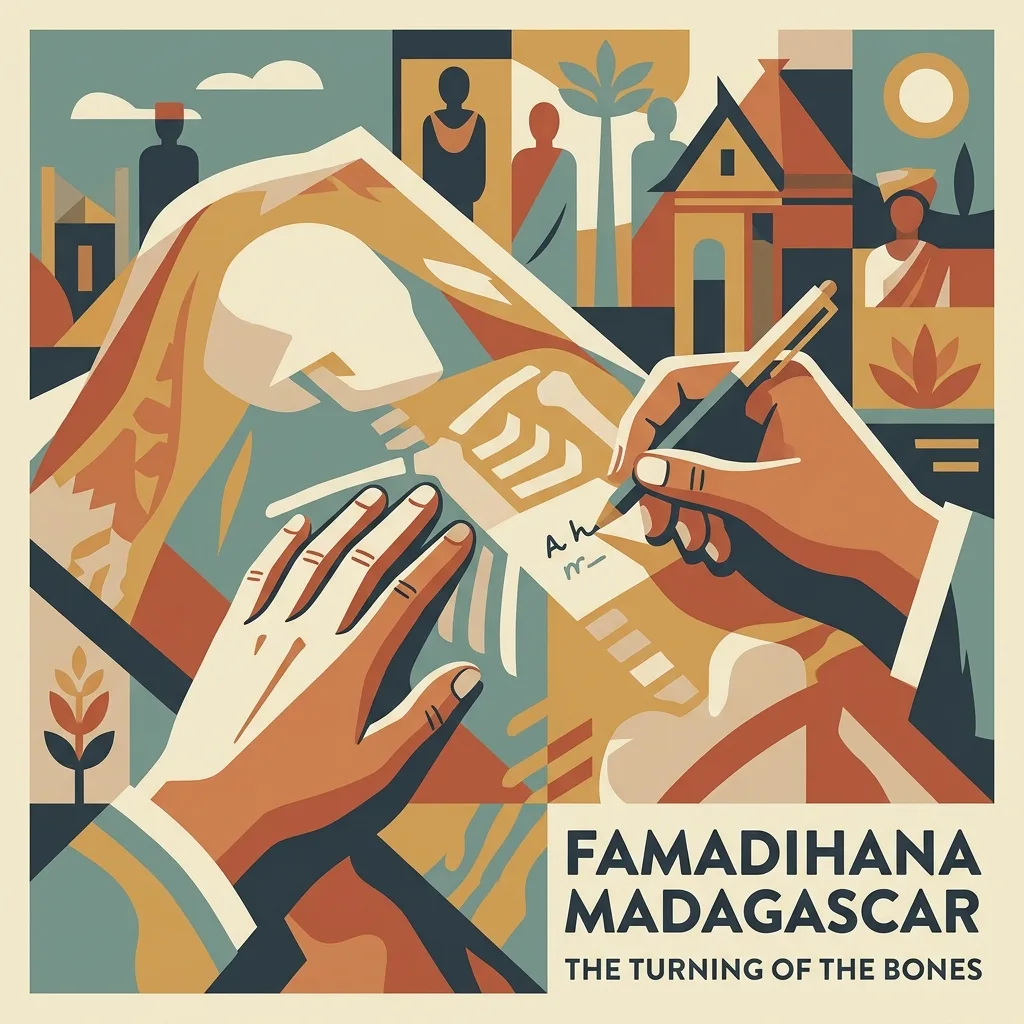
The dead send word through dreams.
Typically, a family member begins dreaming of an ancestor complaining that they feel cold — that the shroud has worn thin, that they need fresh cloth.4 Anthropologist David Graeber, who spent time in Imerina between 1989 and 1991, documented cases where families who ignored these dreams suffered what the community interpreted as ancestral punishment.5 The pull of famadihana is not merely cultural sentiment. It is experienced as obligation.
Which explains something that would otherwise seem impossible: during Madagascar's 2017 pneumonic plague outbreak, the government explicitly banned famadihana for individuals who had died of plague. The Yersinia pestis bacteria can survive on corpses inside sealed tombs for years; handling the remains during a ceremony creates a direct transmission pathway.6 Madagascar accounted for roughly 75% of all plague cases reported globally as of 2017, and the central highlands — where famadihana is most practiced — sit at the heart of the endemic zone.7
Some families defied the ban anyway.
That isn't recklessness. Or at least, it isn't only recklessness. When an ancestor appears in your dream, cold and asking for help, the calculus is different. The health ministry issues warnings in the present tense. The razana make requests from a register that transcends it.
What Does Three Days in a Malagasy Village Actually Look Like?
The ceremony runs over one to three days.
Day one is for receiving: relatives arrive from across Madagascar and the diaspora, carrying contributions of money, rum, rice, and live zebu cattle. The air over the village fills with the smell of vary be menaka — rice simmered low and slow with fatty zebu meat — the ceremonial dish at every famadihana8 — and the syncopated brass-and-drum pulse of hira gasy, traditional Malagasy musical theatre that has been the soundtrack of ancestor celebrations since the 18th century. Day two involves the aterin-ka alaho, the communal collection where each guest gives according to their means, reinforcing fihavanana — the Malagasy ethic of kinship solidarity that makes collective financing of the ceremony possible.8
Then comes day three.
The tomb is opened. In Malagasy culture, the tomb is typically a more substantial and expensive structure than the house the family occupies — the dead command the better real estate.6 A single whitewashed stone vault might hold between thirty and a hundred remains. Men enter first. Wrapped bundles emerge — some still intact, others reduced to bones and dust. Each ancestor is unwrapped from the rotting, earth-stained shroud and lovingly rewrapped in fresh lamba mena. Family members trace the outlines of skeletons through the cloth, rearranging bones to maintain a human shape. The names of the deceased are rewritten on the new silk each time, so they will always be remembered.
Then the bodies are hoisted over shoulders and carried in a jubilant procession around the tomb — three circuits, by tradition — while musicians play upbeat songs and rum is poured over the shrouds. "Drink, grandfather!" Elders tell children who each ancestor was. Bodies must be returned before sunset. Pointing at them is fady — strictly taboo.
Rakotonarivo Henri, speaking to Star News, framed the logic plainly: It is good to thank the ancestors in person because we owe them everything. We do not come from mud; we come from these bodies.
4
The atmosphere sits somewhere between solemn reverence and genuine celebration. These are not mourners. They are hosts.
Who Is Still Doing This — and Why Does It Matter to Them Now?
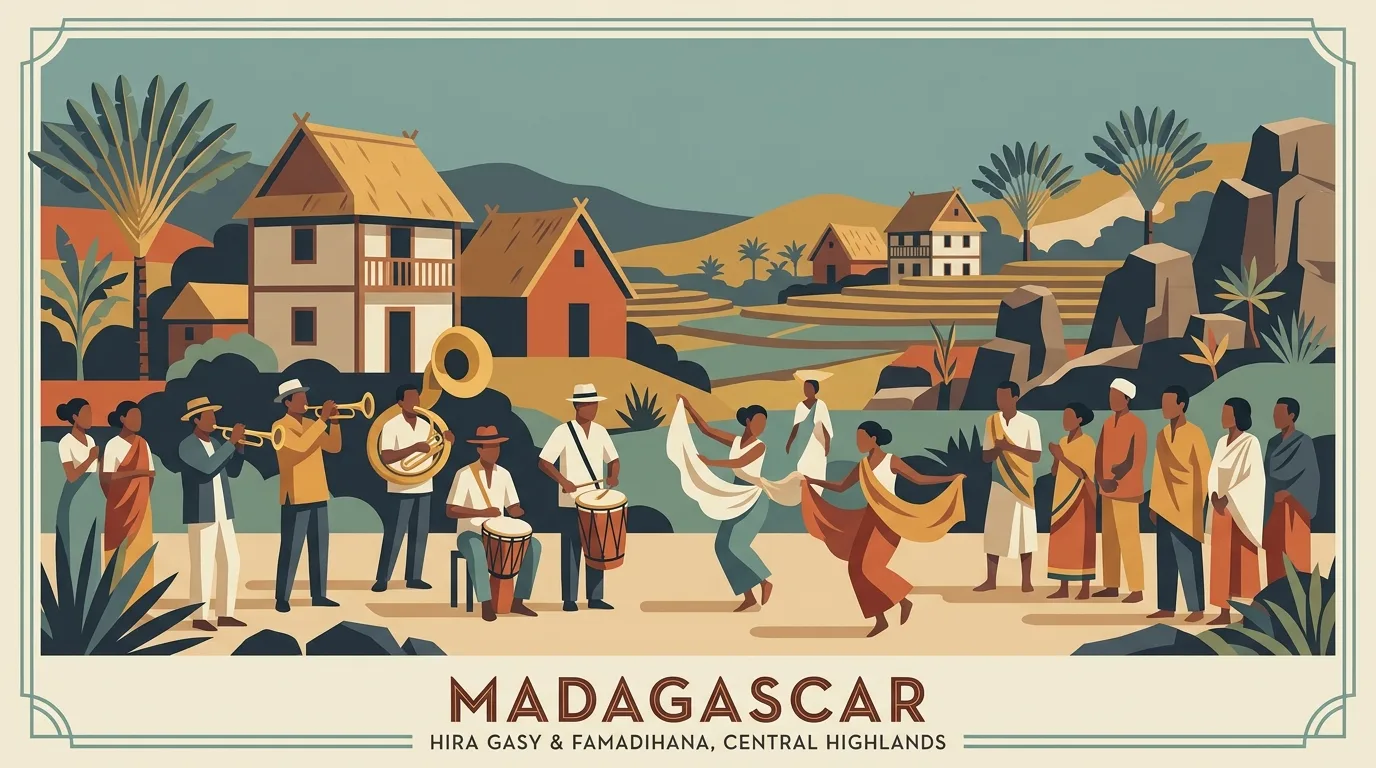
In July 2025, a 25-year-old woman named Fitahina attended a famadihana in the Vakinankaratra region to meet her grandmother for the first time. Her grandmother had died before she was born.8
She told no comment® Madagascar: I am happy to meet her because I never knew her.
She had been waiting a long time, she said; she missed her grandmother, planned to draw close to her shroud at the tomb and tell her the good and bad of her life — confident the dead could still hear.8
Fitahina is not an outlier. After COVID-related suspensions in 2020 and 2021, famadihana returned strongly in 2023 — the Vakinankaratra region alone recorded more than 130 permit applications in a single month that August.8 Recent reporting, including a July 2025 article from no comment® Madagascar, has documented young people reviving ancestral rites as a search for identity amid unemployment and social instability.8
The ceremony is not without its tensions. A single famadihana costs between $2,300 and $11,700 in a country where GDP per capita sits at around $500 — potentially multiple years of family income.5 That financial weight creates real pressure, particularly on younger generations asked to host ceremonies they can barely afford. The cost is not incidental to the practice; it is part of it. The sacrifice is the point. Slaughtering a zebu, buying lamba mena silk, feeding a hundred guests for three days — these expenditures are themselves expressions of hasina, the sacred life force that flows from ancestors to the living and must be honored in kind.
There's also a quiet theological split happening. The Catholic Church now permits famadihana, classifying it as cultural rather than religious practice.1 Evangelical Christians have increasingly walked away from it entirely. For some families, the ritual is still the living center of their spiritual cosmology. For others, it is becoming something closer to heritage — still practiced, still felt, but carrying a different weight.
Neither of those trajectories has yet resolved. For Fitahina's family in Vakinankaratra, gathered in the dry July air with the tomb open and the drums going, the question of whether famadihana is theology or culture probably feels like a distinction that only outsiders would bother making.
Her grandmother could hear her. She was sure of it.
QCan anyone attend a famadihana, or is it strictly family-only?
QHas the Malagasy government ever tried to formally ban famadihana beyond the plague restrictions?
QWhat happens to the old shroud after rewrapping?
QIs there an equivalent practice anywhere else in the world?
QWhat is the significance of the odd-year intervals between ceremonies?
Show all 10 wordsShow fewer
Correspondence.