


Thailand's Wai Has Four Different Heights — and You're Probably Doing It Wrong
The wai — Thailand's palm-pressed greeting — is not a gesture you either do or don't do. It is a vertical scale. Hands at chest mean one thing. Chin means another. Nose means something else. Forehead means you are in the presence of someone whose status sits so far above yours that the gesture becomes almost a posture of prayer. The problem for most foreigners is that they treat this scale as a single note — and play it the same way, every time, to everyone.
What Does Hand Height Actually Signal?
Start with the architecture of it. Palms pressed together, fingers pointed upward, a slight bow of the head.
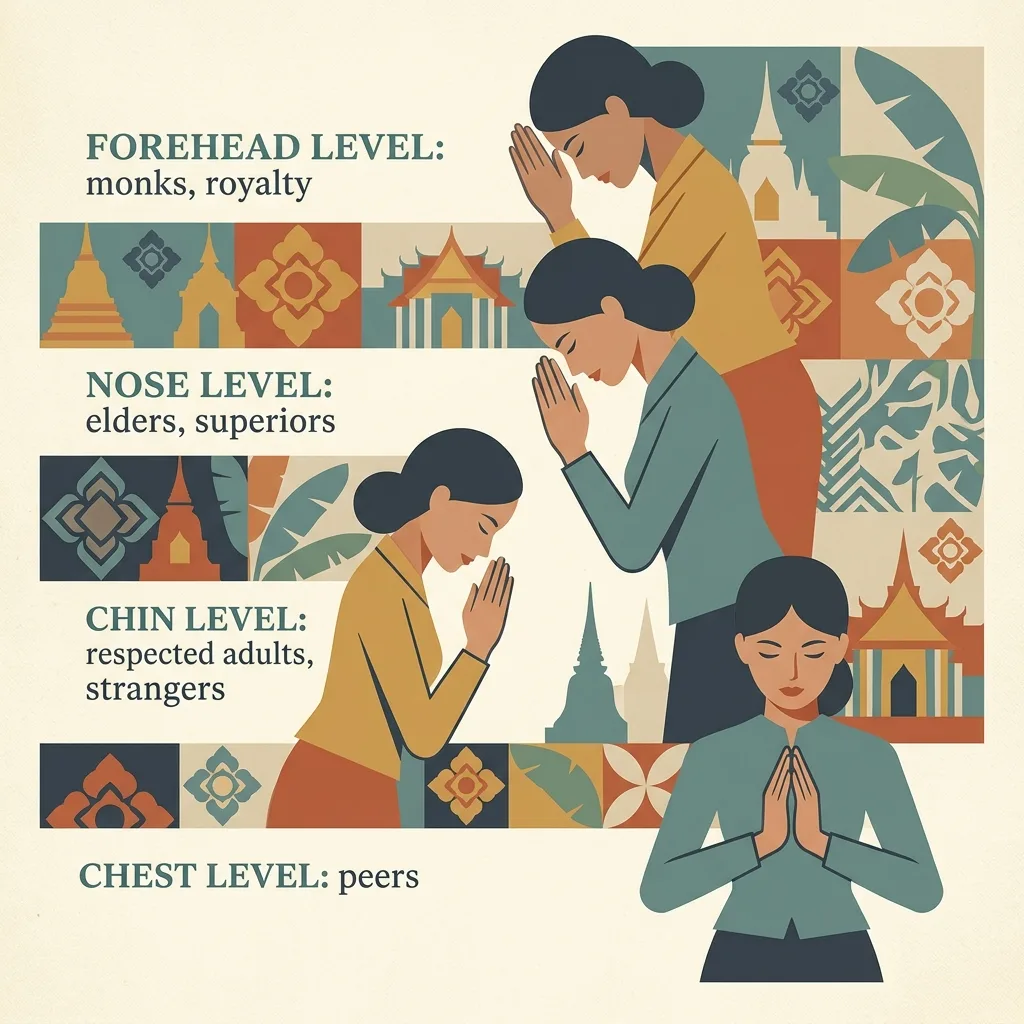
To a peer — a colleague of similar age or rank, someone you are meeting casually — hands sit at chest level. To someone you respect in a general way, perhaps an adult stranger or a shopkeeper you see regularly, chin height. To a parent, teacher, employer, or any elder you hold in genuine esteem: nose level. And to a monk or a member of the royal family, hands rise to the forehead or above, the head bowing low enough that the thumbs almost touch the hairline.1
The Ministry of Culture's official etiquette guide, published in 2007, codifies three levels. Many contemporary guides describe four, splitting the elder category from the monk-and-royalty tier. The Thai government's Public Relations Department still publishes the three-level framework. Neither version is wrong — the taxonomy genuinely has some flex in it — but the underlying principle is non-negotiable: height is a social signal, and every centimeter carries meaning.2
What makes this so hard to read from the outside is the speed of it. On the BTS Skytrain platform at Siam Station around 8:15 in the morning, you can watch the exchange happen in under two seconds: a junior office worker's hands rise to chin height as she spots her department head, the senior woman acknowledges with a barely perceptible nod and a wai returned at chest level — lower, correctly — and neither breaks stride. The information exchanged in that 1.5 seconds would take a paragraph to write out in English.
Why Will Nobody Tell You When You Get It Wrong?
The wai operates inside a broader architecture of face-saving — sia-naa — the loss of social standing through public embarrassment. Correcting someone's wai level, in public, would cause sia-naa for both parties: the corrected person for the error, the corrector for drawing attention to it. So the mistake is absorbed. Filed away. Never mentioned.3
This is the mechanism that makes the wai a genuine invisible trap. You can get it wrong every day for six months and never find out.
Paula Morgan, who has spent twenty years visiting and two years living in Thailand, puts it plainly: "For expats, the social calibration matters more. Over-waiing people who aren't expecting it — a cashier, a street vendor — can come across as odd or even slightly mocking, though it's never meant that way. And in a workplace or formal setting, getting the hierarchy wrong with your wai can create real awkwardness, even if no one says anything."3
The impulse behind the mistake is legible. Egalitarian instinct. Politeness. The desire to show respect to everyone you meet. These are not bad values. But in Thailand's social grammar, treating everyone as an equal is not neutral — it is its own statement, and it reads as confusion rather than generosity.
How Does the System Handle People It Wasn't Designed For?
Foreigners are largely exempt from the full machinery of the wai. The expectation that a tourist on Sukhumvit Soi 11 will correctly read the status difference between a street vendor and a hotel concierge and calibrate accordingly is not realistic, and Thais don't hold it. The courtesy of that exemption is real.
But the exemption has a catch. When a foreigner does attempt a wai — and many do, out of sincere respect — it is still read. The attempt signals intention; the execution signals comprehension. A foreigner who wais everyone at chest level with a warm smile is communicating, unintentionally, that they understand the gesture exists but haven't grasped what it encodes. The wai they intend as universal respect is being received as a declaration of lowest-tier status toward everyone in the room.4
The monk situation makes this starker than anything else. Thailand's Buddhist monks occupy the apex of the social hierarchy — above elders, above employers, above most officials. When you wai a monk correctly, hands at or above the forehead, deep bow, the monk does not wai back. He offers a blessing instead.5 A Western visitor conditioned to expect reciprocal greetings will read this as a snub, or at best a puzzling omission. It is neither. The non-return is the correct operation of the system. Mahidol University's official guide to Thai customs explains it directly: where the social distance is great enough, the wai is simply not returned.6 What looks like being ignored is actually confirmation that you read the room exactly right.
What Is the Wai Actually Doing, Beneath the Greeting?

The gesture's origin is worth sitting with for a moment. The wai descended from the Indian Añjali Mudrā, a yogic hand position that entered Thai culture through Buddhism.7 The oldest recorded function of the open-palmed press was essentially a proof of absence: see, nothing in my hands. No weapon. Peaceful intent made visible through the body.
That seed of meaning is still present. A 2014 peer-reviewed study in the Journal of Intercultural Communication, drawing on essays written by Thai participants, identified five distinct social functions: utilitarian greeting and thanks, status-marking, national identity, personal enhancement — making yourself appear appropriately respectful — and religious homage.8 One subcategory that the researchers noted with some surprise was using the wai as a de-escalation tool: offering a submissive wai to appease a bully, deploying the gesture's status logic tactically to defuse a threat.
This is not what most tourists are thinking about when they press their hands together outside a 7-Eleven. But it helps explain why getting the level wrong in a professional or formal context lands differently than getting it wrong with a stranger on the street. The wai isn't decorative. It is a running negotiation about where everyone stands.
In June 2024, Thailand's Cabinet formally recognized the wai as a national identity marker alongside the Thai elephant, the ratchapruek flower, and the Naga serpent.9 A gesture of indeterminate ancient origin, now officially codified — though the classification of how many levels it has remains, with characteristic Thai practicality, a matter of some polite disagreement.
What Does This Look Like in Practice Right Now?
At Wat Pho, on sun-hot stone with bare feet, the exchange unfolds daily. The forehead-level wai from a visitor, the gentle nod and spoken blessing in return, the visitor's brief flicker of confusion at the absence of a reciprocal gesture. At Thong Lor's upscale restaurants, experienced host staff will modulate every wai without appearing to think about it: nose-level, slow and genuine, for an elderly regular; chest-level with a quick smile for a young couple; a verbal sawatdee krap and a nod for a foreigner fumbling with a phone, the staff correctly sensing that forcing a wai exchange would create awkwardness rather than connection.
What makes the system work, and what makes it so opaque from outside, is that it was never designed to be read consciously. Thai children absorb the calibration the way they absorb the difference between formal and informal speech — not as rules but as texture. The phuu-yai (senior person) and nong (younger person) relationships that structure Thai social life are already encoded in how you address someone, in whether you arrived first, in what you are wearing. The wai is just one more register of the same information, transmitted through the body at a speed that bypasses language entirely.10
The foreigner's error is not ignorance of the rule. It is the assumption that a greeting is just a greeting.
QIf Thais won't correct you, how do expats actually learn the right level to use?
QDoes the wai change meaning depending on whether it accompanies sawatdee, or is used silently?
QHas the wai been formally studied outside Thailand as a model for non-verbal status communication?
QAre there situations where even Thais get the wai level wrong?
QHas the recent official recognition of the wai as a national symbol changed how it is being taught or discussed in schools?
Show all 6 wordsShow fewer
Correspondence.