


Japanese Tourists Fly 9,000 Kilometres to Watch Men in Bearskins Dance in a Romanian Coal Town
The ceata — the bear pack — arrives before dawn.
In Comănești — a small industrial city in Romania's Moldavia region at the edge of the Carpathians, where the central square is ringed by concrete apartment blocks built for coal miners who mostly left decades ago — December 30 begins with drums. Goatskin drums beaten with wooden mallets, seven distinct rhythms, reverberating off Soviet-era facades before the sky has turned grey. Then the bears emerge from minibuses. Dozens of men, each bent nearly double under a full bearskin — head, claws, fur, jaw wired open to show the teeth — carrying 40 to 50 kilograms of cured hide that smells of cedar, cold, and generations of sweat. Among the crowd watching this year: tourists from Japan, who flew roughly 9,000 kilometres for it.1
This is Jocul Ursului — the Bear Dance. It is older, stranger, and more precarious than it looks.
What Does a Bear God Have to Do With New Year's Eve?
The short answer involves a deity named after a bearskin.
Romanian ethnographers trace Jocul Ursului to the Geto-Dacians, a pre-Roman people who inhabited the Carpathian region roughly 2,000 years ago.2 Their supreme god, Zalmoxis, was said to have been wrapped in a bear skin at birth — the name itself derived from zalmos, the Thracian word for skin. Herodotus wrote about Zalmoxis. The bear, in Geto-Dacian belief, was sacred: an intermediary between the living and the dead, a creature that died each winter and returned each spring.
The modern ritual keeps that structure intact. Each performance ends the same way: the bear falls. Collapses to the ground, motionless. Then rises again. Old year dying, new year born.
Whether the 2,000-year lineage is strictly unbroken is contested — historians note the continuous thread is inferred rather than archaeologically proven, and the modern festival is substantially different from its ancient precursors. But the symbolic architecture is unmistakable. This is not a folk costume parade. It is a death-and-resurrection ritual wearing a very specific animal's face.
What Does It Actually Feel Like to Carry 50 Kilograms of Bear?
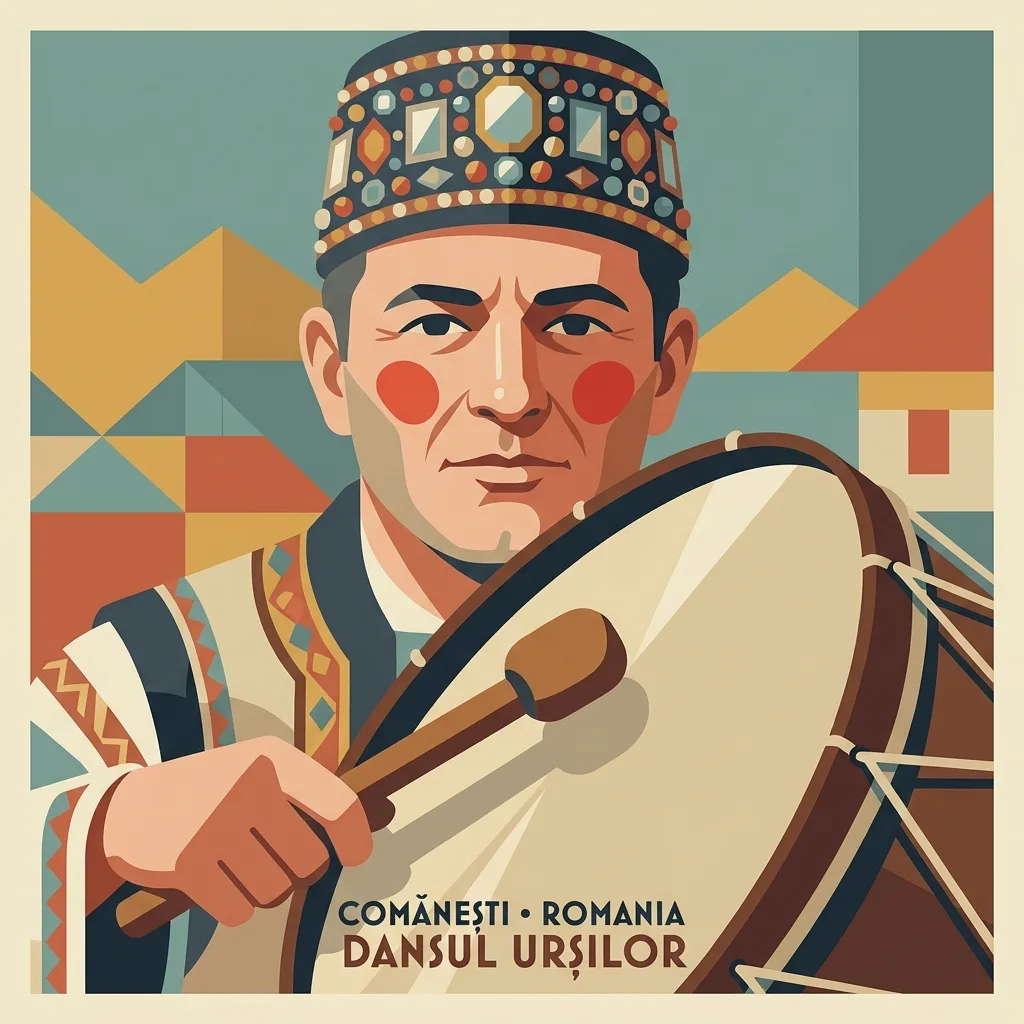
The bearskins weigh between 40 and 50 kilograms. A high-quality costume costs up to €2,000 — close to two months' average Romanian salary.1 The skins are guarded like heirlooms; each ceata keeps its preservation methods secret. Red pom-poms the size of dinner plates are sewn onto the shoulders. The jaws are wired open.
And then you dance for hours.
Cosmina Neamtu, a bear dancer from the village of Dofteana, told Ingrid's Block in 2026: "The weight doesn't matter when the drums start. You forget everything."
3
That might sound like bravado. The toboșari — the drummers — play seven distinct rhythms for seven different dances: Alunelul, Polca, Țărăneasca, Sârba irozilor, Ursăreasca, Marșul irozilor, Combaterea.4 Each ceata has its own sequence. No two packs dance the same way. The drummers' cheeks are painted red, their caps studded with mirrors and beads. The irozi — masked figures in military-style costumes carrying wooden swords — move between the bears. Children from the Sipoteni pack, some as young as three, stumble through the steps in smaller skins.
Costel Dascalu, who founded the Sipoteni ceata and started participating at age eight under communist rule, described the pull of it to the Associated Press: "The bear runs through our veins, it is the spirit animal for those in our area. Our breath smells like bears, and we get goose bumps when we hear the sound of drums."
1
His children, Amalia and David, are already in the pack.
Where Did the Real Bears Go?
Here is what the festival photographs don't show: it used to involve actual bears.
For centuries, the ursari — Roma bear-handlers who formed a professional community, often enslaved or trafficked — trained live bears and took them door to door through Moldavian villages at the winter solstice.5 The bears danced because they had been conditioned to do so on hot metal surfaces, learning to lift their paws in a motion that looked, from a distance, like dancing. The practice was restricted under the communist regime and made fully illegal in 1998. The last performing bears in Romania were retired to a reserve in Bulgaria's Rila mountains when Romania joined the EU in 2007.5
What exists now — men in bearskins — is a parallel tradition, older than the live-bear performances and running alongside them for centuries, that survived when the other did not. Whether that makes Jocul Ursului a purer form of the original ritual or a sanitized substitute depends on who you ask. The ursari are still part of the ceata; in the modern performance, they are the human handlers who accompany the costumed bears, the title having outlasted the role that created it.
The animal rights concern didn't end with the live bears either. The bearskin costumes require, by definition, dead bears. Romania banned trophy hunting in October 2016 after 2,374 bears were legally shot under hunting quotas between 2007 and 2015 alone.6 A 2026 Romanian Environment Ministry study found the country now holds between 10,600 and 12,700 brown bears, the largest population in Europe, and roughly three times what its habitat can sustainably support.7 The country with Europe's bear crisis is also the country where the bear is a sacred ancestral costume. The tension does not resolve neatly.
Is Anybody Trying to Save It?
The UNESCO application for Jocul Ursului has been pending since 2011.8 As of May 2025, a Romanian deputy pledged to "unblock" the bid, which had stalled in bureaucratic process.8 Fourteen years is a long time for a recognition application — long enough that the delay itself has become part of the story.
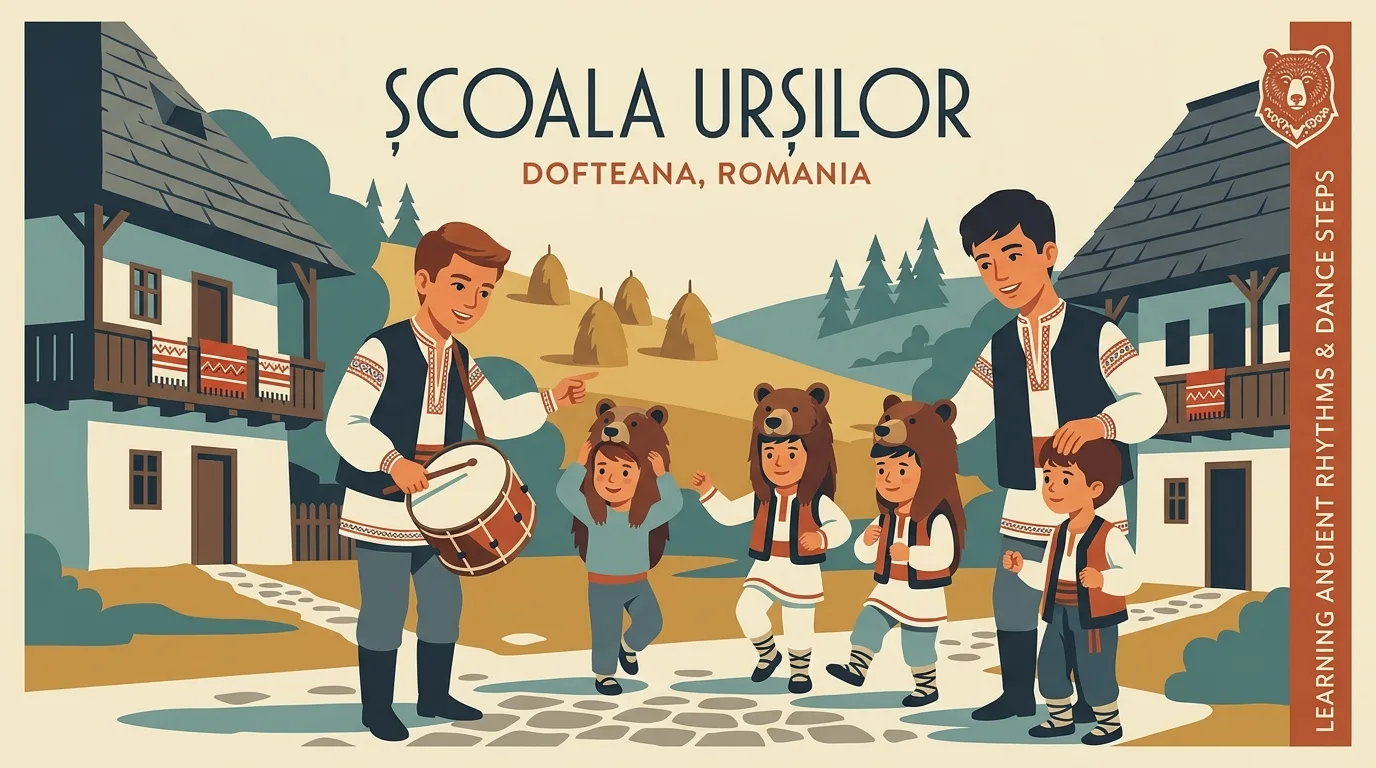
The threat from emigration is more immediate than any institutional failure. AP News reported in 2018 that locals already feared the tradition might disappear as young Romanians left for Western Europe.5 That flow has not reversed. In Dofteana, boys as young as eight attend the Școala Urșilor — Bear School — where older youths teach them drum rhythms and dance steps.4 They cannot perform in the main ceata until they turn 18, a decade-long apprenticeship. The assumption embedded in that structure — that a boy who starts at eight will still be in the village at eighteen — is no longer guaranteed.
In 2025, the Romanian Ministry of Culture allocated 50,000 lei to a preservation project in Dărmănești specifically aimed at passing the tradition to younger generations.9 The money matters less than what it signals: the tradition now requires institutional rescue funding, not just community memory.
In the villages of Dofteana and Dărmănești, the ceata still goes door to door on New Year's Eve. Householders who refuse to receive the bears are said to face bad luck all year.2 In Comănești, the performance happens on a stage in the central square, ticketed, lit, filmed. Both things are true at once: the ritual is alive and performing, and the conditions that sustained it for two millennia are quietly eroding.
The bears still rise at the end. For now.
QHas Romania ever had other winter rituals involving animals, or is the bear dance unique?
QWhat happens to a bearskin costume when it's too old to use?
QDo women participate in the bear dance?
QWhy specifically Japanese tourists?
QIf the UNESCO application succeeds, does that actually protect the tradition?
Show all 6 wordsShow fewer
Correspondence.