


Lisbon Cafés Charge Three Different Prices for the Same Coffee
In Lisbon, the same coffee costs three different prices in the same café — depending entirely on where you're standing when you drink it.
Stand at the balcão — the zinc counter that runs along the front of almost every traditional Lisbon café — and a bica, the local word for espresso, costs around €0.80. Sit down at an interior table, a mesa: €1.10. Take it outside to the esplanada, the pavement terrace: €1.40. Same café. Same coffee. Same barista.
This isn't a pricing quirk. It's Portuguese law.
Why Does the Same Coffee Cost Three Different Prices?
The law — Decreto-Lei n.º 10/2015, if you want to look it up — says cafés can charge different prices across different zones, as long as the price list is posted somewhere.¹ And it is posted. Usually in Portuguese. Usually small. Usually near the entrance where nobody thinks to look.
The system is technically transparent. It's just invisible to anyone who didn't grow up inside it.
The gap between counter and table runs roughly 20–40%.¹ In a working-class café in Mouraria, a bica at the counter costs around €0.80. At a table, €1.10. On the terrace, €1.40. At A Brasileira in Chiado — the famous café where Fernando Pessoa's bronze statue sits outside — the terrace bica was €2.20 in 2023. Nearly three times the price of a counter coffee two streets away.
The most scenic seat in a Lisbon café is the one that locals would never sit in.
What Does the Counter Actually Mean?
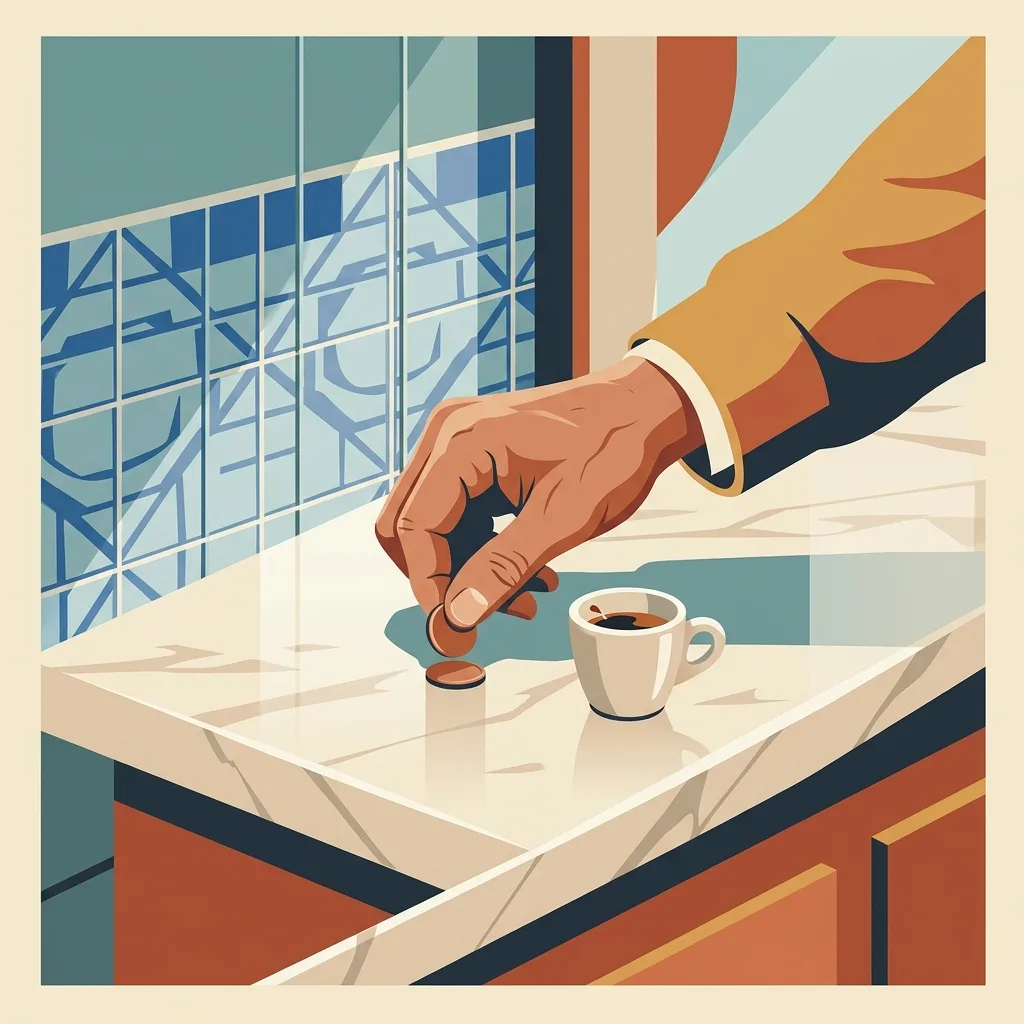
The balcão isn't just cheaper. It's been the laborer's domain for roughly 250 years.
Lisbon's café culture descends from the casa de pasto — cheap, standing-room eating houses for urban workers that packed the city in the 18th and 19th centuries.¹ When those evolved into the modern café, the counter came with them. Not as a design choice. As an inheritance.
The counter itself tells you everything. Marble or zinc, 90 to 110 centimeters high, no stools. Standing isn't incidental — it's the whole point. The message is simple: drink your coffee, get back to work.
And it's fast. Two minutes at the counter, bica downed, coin on the marble, gone.
Lisbon has roughly one café per 130 residents. Paris has one per 300.¹ At that density, cafés aren't cultural amenities. They're utilities — as essential to daily life as a bus stop or a pharmacy. Treating them as tourist attractions is, in a very real sense, the original sin of the visitor's encounter with this city.
What Signals Belonging — And What Gives You Away Immediately
The first thing that gives you away is what you call the coffee.
In Lisbon, ordering an "espresso" — or worse, just a "coffee" — and something shifts. Nobody makes a scene. The barista just clocks it. Service slows slightly. You might get gestured toward a table rather than the counter.¹ In Porto, incidentally, they don't even call it a bica — there it's a cimbalino. Same drink, different city, different word entirely.
There's a whole secondary vocabulary after that. A garoto is a small coffee with a splash of milk. A galão is large and milky, served in a tall glass. A meia de leite is half coffee, half hot milk, in a cup. Knowing the difference doesn't make you a local. But it signals that you've at least paid attention.
But the deepest signal isn't verbal. It's the caderneta.
In older Lisbon cafés, regulars don't pay every time. They run a tab — not on an app, not on a card, not on any signed agreement. The barista just knows. Knows the face, knows the order, knows roughly what's owed.
There's no way to ask for one. You either have it — because you've shown up enough mornings that you became part of the furniture — or you don't.
No tourist has ever had a caderneta.
How Gentrification Is Quietly Changing All of This
A Brasileira has been serving coffee in Chiado since 1905. It still has a counter, interior tables, and a terrace. The Fernando Pessoa statue outside — installed in 1988, not some ancient fixture — turned that terrace into one of the most photographed spots in Lisbon. Which means the place that best embodies the old three-tier system is also the place where that system has most completely broken down.
That's the pattern playing out across the whole city. Between 2015 and 2023, Lisbon's Airbnb listings grew from around 4,000 to over 22,000 — concentrated in Alfama, Bairro Alto, and Chiado, the exact neighborhoods where this culture ran deepest.¹
In Mouraria alone, 34 traditional tascas and cafés closed in 18 months, replaced by specialty coffee shops charging three to five times the price of a bica.¹ Lisbon's third wave — terceira vaga — brought flat whites at €3.50, no counter, no tiered pricing, no caderneta. A culture that took 250 years to build is quietly making way for something newer.
It's not happening everywhere at the same pace. On the side streets of Mouraria, on Rua dos Correeiros in Baixa, the old system still works. The barista still knows the regulars. The prices are still tiered. These places still exist — and they're worth seeking out.
But with each passing year, a 250-year-old tradition makes a little more room for a new Lisbon. A different city. One where the counter means something different than it used to.
What's Being Lost
What's disappearing isn't cheap coffee. It's a social technology that took 250 years to build — one that let an electrician from Mouraria walk into a room, pay less than the tourist two seats over, get recognized before he said a word, and run a tab on the honor of his face.
That kind of dignity doesn't survive a €4.50 oat milk cortado.
QIs the three-price system actually enforced, or do cafés just do whatever they want?
QDo other European countries have similar tiered café pricing?
QWhat happened to café culture in Lisbon after COVID?
QIs there any movement to protect traditional Lisbon cafés?
QWhy do Lisbon locals stand at the counter rather than sit down, beyond the price difference?
Show all 11 wordsShow fewer
Correspondence.