


Nollywood Began Because a Nigerian Trader Couldn't Sell His Blank VHS Tapes
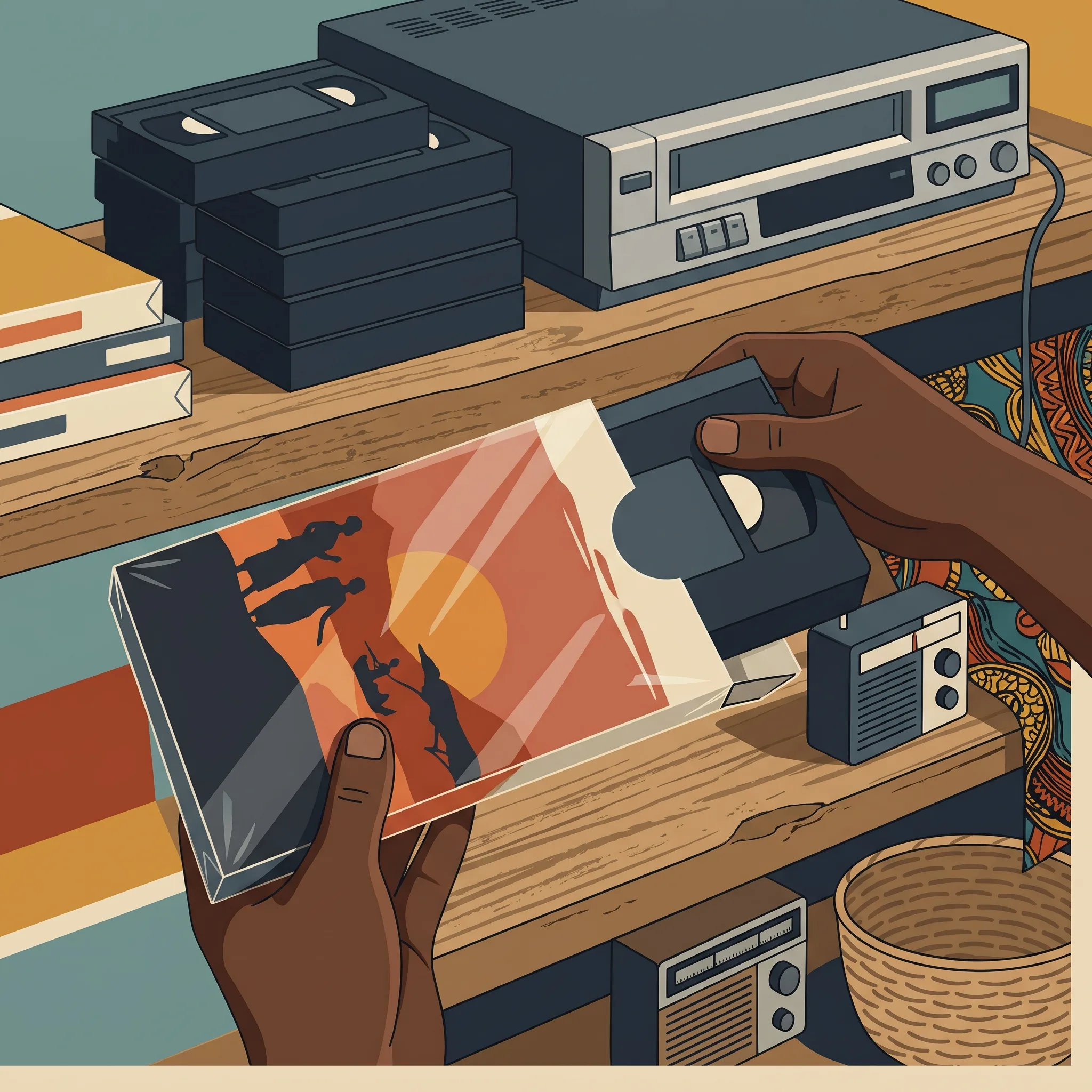
In 1992, the Fulbright scholar Jonathan Haynes was going through cassettes at an open-air stall in Nsukka, a university town in southeastern Nigeria. The shelves were rough wood, and most of the tapes held music or pirated foreign films. Then he found something he would later call a strange object. It was a Nigerian film in a full-color printed jacket, sealed in cellophane, dressed exactly like a Hollywood release.1 The film was Living in Bondage. The man who paid for it was, first and foremost, in the business of selling tape.
A Warehouse of Empty Tape
Kenneth Nnebue traded electronics and cassettes between Onitsha and Lagos. According to The Economist, he had a large stock of blank videocassettes imported from Taiwan. He reckoned they would sell better with something already recorded on them.2 So he financed a movie. Living in Bondage was an Igbo-language drama released straight to video. By The Economist's count it sold more than 750,000 copies, and the home-video boom that followed eventually got a name: Nollywood.2
It's a perfect origin story. It's also a little too tidy.
Nnebue was no accidental mogul. The film historian Jonathan Haynes interviewed him in 1997 and 2002, and he traces a much longer road. Nnebue left school after the sixth grade, apprenticed with his brother as a handbag maker, and traded handbags in Onitsha Market.3 By 1989 he was financing Yoruba-language videos. The first cost 2,000 naira, roughly $200. It was shot on a single VHS camcorder and edited by wiring two VCRs together.3
Even the famous sales figure wobbles. Estimates run from about 200,000 copies to beyond 750,000, and no one can cleanly separate legitimate copies from pirated ones.3 The certain part is that an enormous number of Nigerians watched it, and that the packaging mattered almost as much as the story.
The Cinemas Went Dark First
Nnebue had already been making videos for three years. So why did this one become an industry? The answer starts in 1986.
That year, General Ibrahim Babangida's government launched an IMF-backed Structural Adjustment Program. The naira was devalued, and imported celluloid film stock became ruinously expensive.34 Around the same time, rising urban crime made people afraid to go out to cinema halls after dark.4 By the end of the decade, Nigeria's lively 1970s film and theater culture had collapsed.3
The trader's tapes and the empty cinemas look like cause and effect. They are really two results of the same shock. Structural adjustment made film expensive and nights dangerous, and it left a country full of VCRs with almost nothing local to play on them.
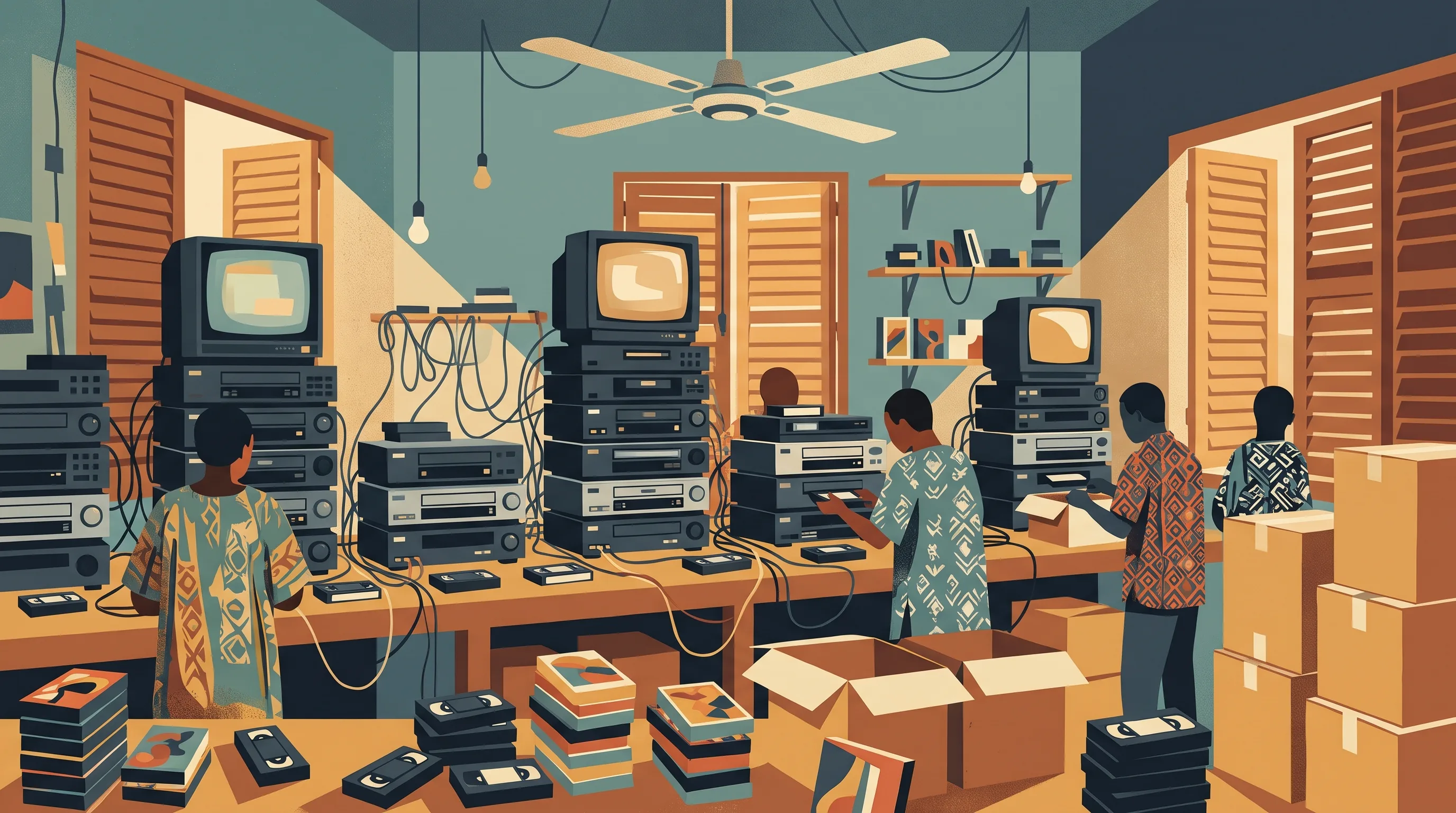
The distribution system was already in place, too. The anthropologist Brian Larkin showed that Nollywood grew directly on top of Nigeria's piracy infrastructure.5 The high-speed dubbing machines, the Taiwanese blank cassettes and the market networks of Idumota, Alaba and Onitsha had all been built to bootleg Hollywood, Bollywood and Hong Kong films. Nnebue simply ran a Nigerian movie through the same pipes.
A Hawker, a Diploma and a Borrowed Name
The trader still needed someone who knew how to make a film. That turned out to be Okechukwu "Okey" Ogunjiofor, a 1987 graduate of the NTA Television College in Jos. He couldn't find work, so he had been selling beauty products and cassettes in Lagos traffic.6 One day he wandered into a rehearsal at the National Arts Theatre and started correcting the staging.
The cast didn't throw him out. They got curious instead. One of the ladies among them, Ruth Osu, a known face on television then, called me aside and asked to know more about me.
That's how Ogunjiofor recalled it to The African Courier. Osu was moved by his story and wrote him a note to Kenneth Nnebue of NEK Video Links.6
The pitch did not go smoothly. Ogunjiofor wanted 150,000 naira to shoot on professional-grade tape instead of ordinary VHS. Nnebue protested that the money could make three Yoruba films. Then he told Ogunjiofor to go home and bring back his school certificate.67 Nigeria's most famous movie got its budget only after the trader had inspected a diploma.
Then there was the director. Chris Obi Rapu was a programme controller at the state broadcaster NTA, and civil-service rules barred him from private work. So he signed the film as "Vic Mordi," his wife's maiden name, and took 10,000 naira for the job.8 Ogunjiofor played the villain for 500 naira. Television soap stars got 1,000 naira each, reportedly the first time Nigerian video actors were paid in thousands.7
This professionalism is the part the blank-tape legend tends to leave out. Ogunjiofor and Obi Rapu have both argued that the film worked because trained television people brought broadcast-quality acting and pacing to a cassette trader's network.7
Money Medicine
The plot was built to grab an audience. Andy Okeke, played by Kenneth Okonkwo, joins a secret cult and sacrifices his devoted wife, Merit, in exchange for instant wealth. Her ghost haunts him until he is living deranged under a Lagos flyover. A Pentecostal church finally rescues him.3
The film launched a genre built around ọgwụ ego, Igbo for "money medicine," the occult rituals said to turn a human sacrifice into riches. Ọgwụ ego stories became one of early Nollywood's signature plots.
That signature has a heavier side. Critics, including members of Nigeria's own House of Representatives, have accused these films of glorifying superstition. They have also accused them of inspiring real ritual murders of young women and children. In 2022, as lawmakers pushed for restrictions, Kanayo O. Kanayo, who acted in the original film, defended the industry to BBC News Igbo. His words: Nollywood as a film production industry is based on what happens in the world. We make films about what happens in society as it happens.
9
Whether these films mirror that violence or feed it is a question Nigeria has not settled.
Fourteen Days, Then YouTube
Back in the markets, every hit started a race. Once a film came out, pirates needed about two weeks to copy it and move it across Africa. Traders called that 14-day window the "mating season." It was their only chance to earn back what they had invested.24
Nnebue learned this the hard way. Haynes reports that Living in Bondage brought in roughly 20 million naira in cash in its first month. Nnebue still lost money on Part 1, because pirates copied it faster than NEK Video Links could get it into shops. He made Part 2 in 1993 with a tighter distribution network.3
More than 30 years later, the trader's model has split in two. West African cinemas grossed 15.6 billion naira across 122 cinemas in 2025. In January 2026, Funke Akindele's Behind The Scenes became the first Nollywood film to pass 2 billion naira at the box office, eventually reaching 2.76 billion.10
At the other end of the business, many filmmakers now bypass the old Alaba and Idumota marketers completely and upload their films straight to YouTube. The actress and producer Ruth Kadiri told BBC News Pidgin that YouTube is now what feeds people in the industry.11 For a working filmmaker, the market stall has turned into a channel page.
The cellophane jacket that stopped Haynes in Nsukka was the whole trick: it made a Nigerian story look like it belonged on the same shelf as Hollywood. Today a Nollywood film either opens in a West African multiplex or shows up free as a thumbnail on a phone.
QDid Chris Obi Rapu direct the sequel to Living in Bondage?
QWhy did Netflix and Amazon pull back from Nigeria?
QWhat does a Nollywood "marketer" actually do?
QWhere were early Nollywood tapes actually sold?
Show all 3 wordsShow fewer
Correspondence.