


The World Nomad Games: The Olympics Nobody in the West Is Watching
The Olympics Nobody in the West Is Watching Is Happening Again This August–September
The World Nomad Games — held near Kyrgyzstan's Lake Issyk-Kul — are a fully-formed alternative to the IOC's calendar. In 2022, more than 3,000 athletes from 102 countries competed in 37 disciplines. Five sitting presidents attended the 2018 edition. The 2024 edition drew 100,000 spectators. Western media barely noticed any of it.
What Actually Happens at These Games?
Start with the headline sport. Kok-boru — literally "blue wolf" in Kyrgyz — is played on horseback. The ball is a goat carcass, traditionally soaked in cold water for 24 hours beforehand to toughen the hide. Two teams of riders attempt to carry it across the field and hurl it into the opposing team's circular goal, called a taikazan. The match runs 40 minutes. The horses are not symbolic. They are athletes in their own right, galloping hard into collisions, responding to weight shifts and knee pressure because the riders' hands are occupied.
In 2017, UNESCO inscribed kok-boru on its Representative List of the Intangible Cultural Heritage of Humanity — the same list that holds the Mediterranean diet, Mongolian throat singing, and French gastronomic culture.¹ The same institutional body that protects Notre-Dame cathedral now protects a game played with a headless goat.
That tension — between "spectacle" and "heritage" — sits at the heart of the entire Games.
Beyond kok-boru, the 2018 programme included 37 disciplines: seventeen distinct wrestling styles, seven forms of archery (including acrobatic foot-archery performed from a handstand), five board games, and eight types of horse racing including a 50-mile endurance event.² The 2026 edition in Kyrgyzstan is expected to feature 40-plus disciplines, with more than 100 medals at stake.³
The Summer Olympics, for comparison, currently features 32 sports.
How Did Something This Large Stay Invisible?
The growth curve is difficult to explain away. In 2014, the inaugural Games in Cholpon-Ata drew 583 athletes from 19 countries competing in 10 sports. By 2022, that had expanded to more than 3,000 athletes from 102 countries, according to the official World Nomad Games records.⁵ The 2024 edition in Astana attracted approximately 100,000 spectators across the competition days — comparable, in raw attendance, to the Super Bowl.
At the 2018 opening ceremony in Cholpon-Ata, 1,500 performers recreated the Kyrgyz legend of creation on a Soviet-era hippodrome field while five sitting heads of state watched from the VIP section: the presidents of Kyrgyzstan, Kazakhstan, Turkey, Hungary, and Azerbaijan.⁶ A diplomatic gathering that would dominate the news cycle at the Olympics. The New York Times ran a brief.
Part of the answer is geography. Cholpon-Ata sits on the northern shore of Issyk-Kul, a lake so large — 6,236 square kilometres, 668 metres deep — it functions as an inland sea. It is also one of the least-visited regions of a country that receives fewer than a million Western tourists annually. There are no major wire agency bureaus in Bishkek. The competitions are not broadcast on any platform with meaningful Western distribution.
But geography is only part of the explanation. The other part is that the Games exist entirely outside the institutional framework through which Western sports media understands events. No IOC involvement. No NBC rights deal. No familiar faces, familiar disciplines, or familiar national narrative hooks. The Games are legible to the Central Asian world and largely opaque to everyone else — which is, incidentally, a reasonable working definition of how most of human cultural life actually operates.
The organiser, Bermet Tursunkulova, described the moment to Radio Free Europe:
Seeing them play at the opening, she said, made it all worth it
— the kind of moment that gives goosebumps to anyone watching, in person or on television.
Are These Ancient Traditions — Or Something More Complicated?
The obvious narrative is that the Games preserve thousand-year-old nomadic practices, connecting modern Kyrgyz and Kazakh people to the steppe cultures of their ancestors. That narrative is emotionally true and factually complicated in equal measure.
Soviet collectivisation in the 1930s forcibly sedentarised Kazakh and Kyrgyz nomadic communities. The living transmission of many of these practices — the daily, generational, oral passing-down of how to play, how to train, how to judge — was broken in the span of a single decade.⁸ Many sports at the Games were reconstructed from ethnographic documentation rather than unbroken practice. Their rules were standardised from academic records.
Daniyar Daukey, founder of the Daukey Kokpar Club in Almaty, told CAPS Unlock that after the Soviet era, Kazakhs were not that good in ethnic things… so everything is new for most of us
.¹⁷
Academic scholars, applying Eric Hobsbawm's "invented traditions" framework, have argued that the Games are partly a post-Soviet nation-branding exercise — a deliberate construction of nomadic identity designed to fill the ideological vacuum left by the USSR's collapse, and to attract foreign investment and tourism.⁹ The concept itself was first proposed not by presidential decree but at a 2007 academic conference in Bishkek on "national physical culture and national sports games." The Games were, quite literally, designed.
Does this make them less meaningful? That's the wrong question. The more interesting one is what it reveals about the experience depending on who you are when you arrive.
For a Kyrgyz elder who remembers — or whose grandparents remember — the toi, the traditional nomadic festival marking the end of the summer migration from the jailoo to winter camp, the Games are a restoration. Something that was taken is coming back. The September timing is not arbitrary: it mirrors exactly that ancient seasonal rhythm, a formalised version of something nomadic communities did every year for millennia.¹⁰
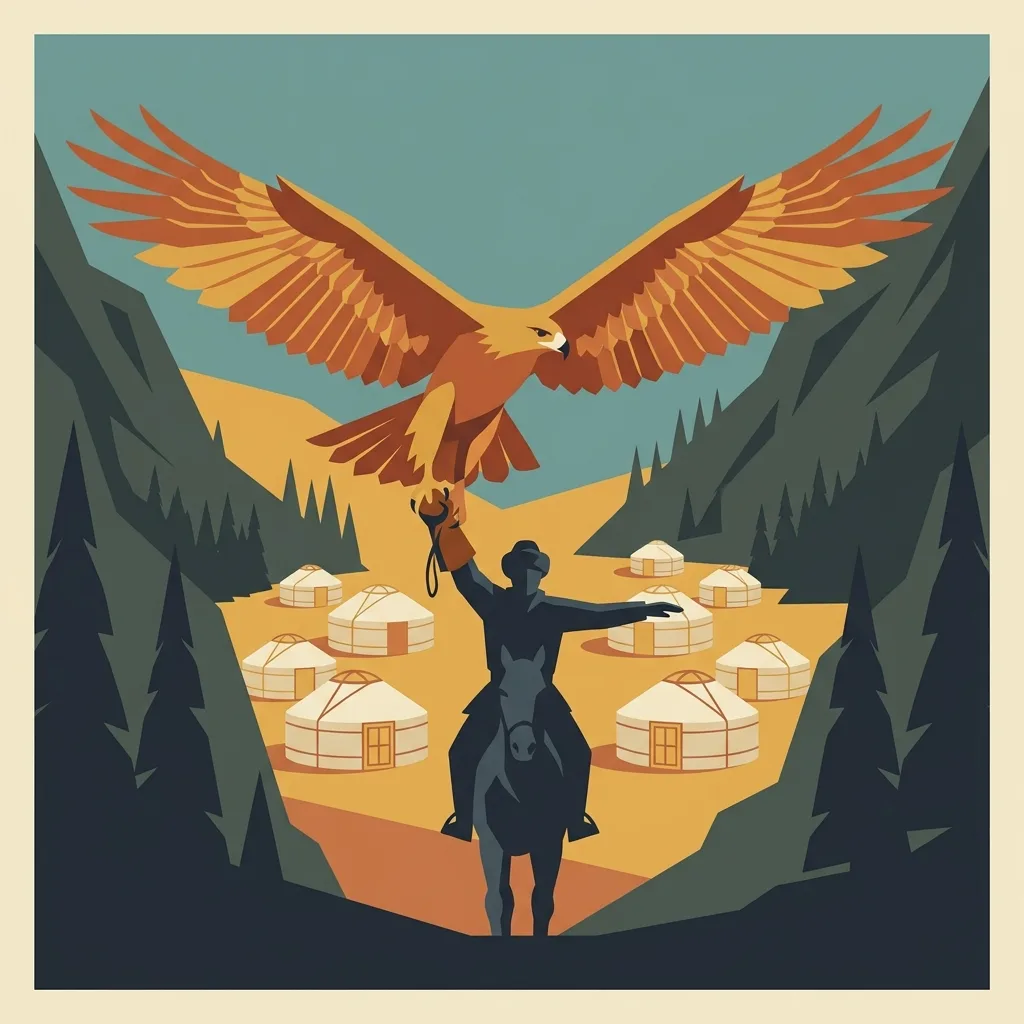
For a Western cultural tourist, the Games are a genuinely remarkable spectacle — eagle hunters with birds spanning 2.2 metres perched on their arms, wrestling arenas that smell of horse and mountain wind, board games played outdoors in circles drawn in the dirt with a stick.
For a Kazakh attendee in their thirties who grew up in an apartment in Almaty, the experience can be something stranger and more poignant: a re-encounter with a heritage that Soviet policy interrupted and that their own government is now reconstructing, partly for them and partly for the tourism economy. As Dr. Ulan Bigozhin of Nazarbayev University put it to The Daily Yonder: "Kazakhstani state-makers identify Kazakhstan as not just a product of the collapse of the USSR. They build a narrative that our history goes all the way back to the Steppe empires of the Bronze Age. And archaeologically, this is true."¹¹
All three of those experiences can be happening simultaneously, in the same hippodrome, to people sitting three rows apart.
What the 2026 Games Are, and Why This Particular Edition Matters
The 6th World Nomad Games open on August 31, 2026 — Kyrgyzstan's Independence Day — with a ceremony at Bishkek Arena stadium. The main competitions run September 2–6 at Cholpon-Ata, on the northern shore of Issyk-Kul.¹³ Delegations from 89 countries are expected.
The structural fusion of national independence and nomadic identity into a single ceremony is itself a statement. Kyrgyzstan is telling a story about what it believes it is — not a Soviet successor state waiting for foreign capital, but the heir to a steppe civilisation that predates the Russian Empire by a millennium.
The venue adds its own layer. Issyk-Kul never freezes, even in January, because of geothermal springs at its floor. Its name in Kyrgyz means "hot lake." Beneath it, in 2006, archaeologists reported evidence of an ancient civilisation estimated to be 2,500 years old — a finding noted in the Wikipedia Issyk-Kul article, though the original archaeological publication has not been independently sourced.¹⁴ The competition arena is, quite literally, built over a sunken world.
There is salburun — the compound hunting discipline combining mounted archery, eagle hunting, and dog hunting simultaneously — where burkut saluu — eagle hunting — sees a golden eagle launch from a rider's arm toward a fox-skin dummy dragged at full gallop. There is er enish, horseback wrestling between two shirtless riders, each trying to pull the other off their horse. There is ordo, a strategy game played by throwing sheep ankle-bones at a central "khan" bone in a circle drawn in the dust — a game that was historically used to train military commanders. There is toguz korgool, a mancala-family board game played with 162 stones across 18 holes, sometimes called the "chess of the steppes," and UNESCO-inscribed in 2020.¹⁵
Most competition tickets are free. Hotel rooms in Cholpon-Ata book out six to twelve months in advance.
The Games have real tensions — the 2024 kok-boru final ended in controversy when a Kazakh player whipped a Kyrgyz opponent and Kyrgyzstan threatened to walk off the field; the Kyrchyn Gorge ethno-village, 45 kilometres east of Cholpon-Ata, risks sliding from living cultural space into performance space as attendance grows. These are real problems that come with real scale.
But they are the problems of something that matters, not something that doesn't.
The World Nomad Games are now included on UNESCO's Register of Good Safeguarding Practices, formally recognised by the United Nations as an instrument of intercultural dialogue.¹⁶ The UN recognises a sporting event most of the West has never heard of as a meaningful contribution to global cultural understanding. That tells you something — about the Games, and about what "global" actually means when Western media isn't the one drawing the map.
In August, 3,000 athletes will gather beside an ancient lake that holds a sunken civilisation at its floor, at an altitude where the Tian Shan peaks reflect off water that refuses to freeze. They will play sports that were interrupted by one empire and revived by the wreckage of another. Whether that is "authentic" is a question for the conference room. What it looks like from the hippodrome stands is something else entirely.
QWhat is kok-boru, and is it as brutal as it sounds?
QHow do the World Nomad Games compare in scale to the Olympics?
QCan anyone attend, or is it primarily a regional event?
QWhat is the Kyrchyn Gorge ethno-village?
QWhy does the timing in September matter culturally?
Show all 14 wordsShow fewer
Correspondence.